Part 2: The Man Who Walked Through the Silence
The ballroom had never been this quiet. A hundred guests, a string quartet, a dozen waiters with silver trays, and not one sound. Even the crystal chandeliers seemed to hold their breath.
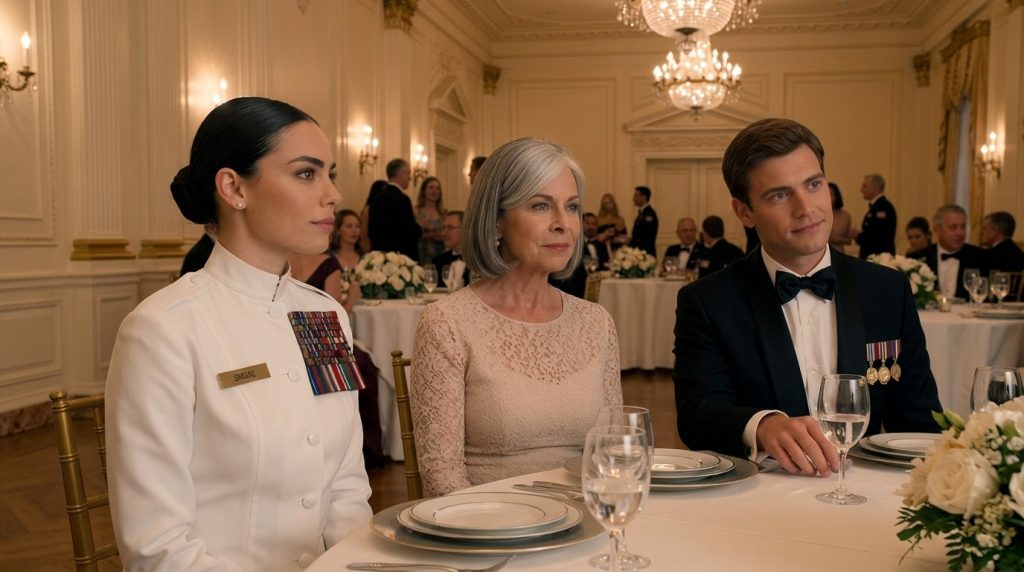
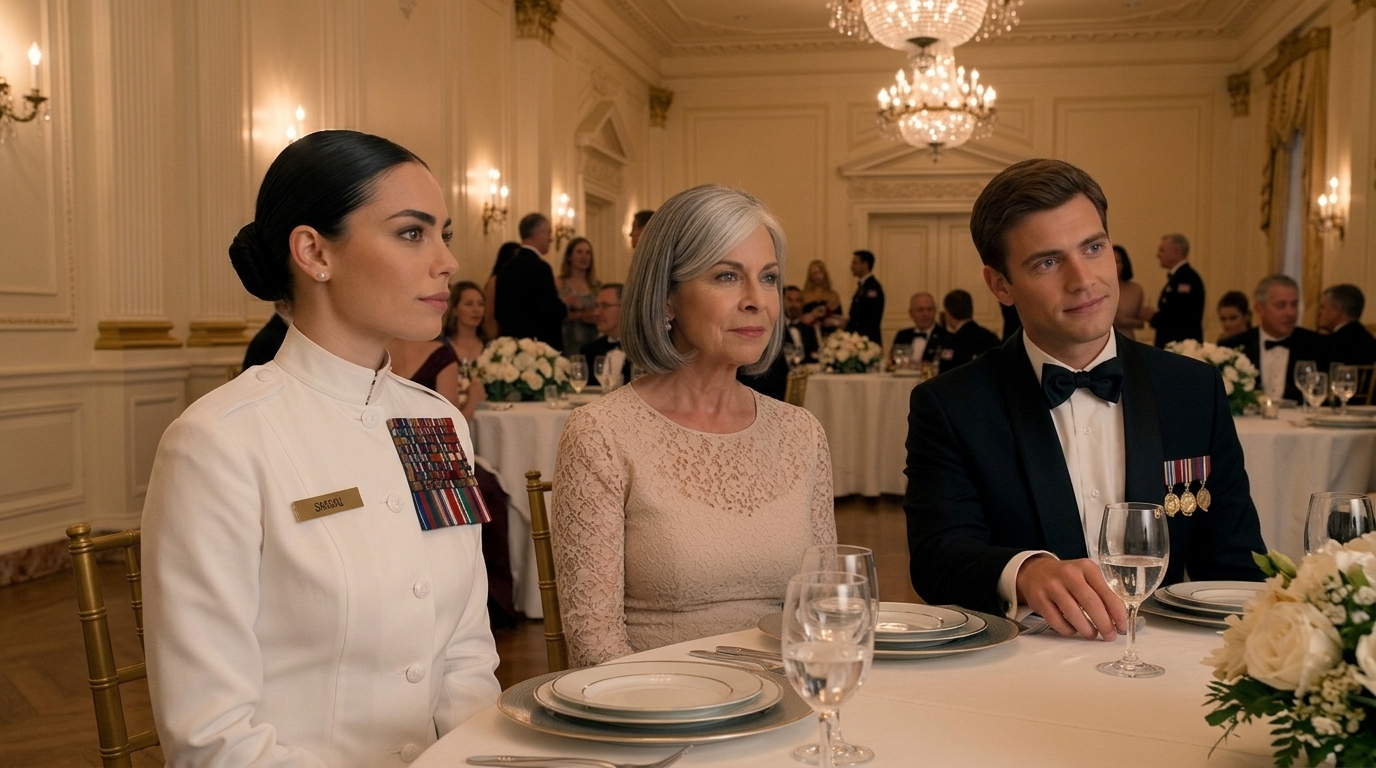
Master Sergeant Marcus Reed reached the round table and stopped. He did not look at the mother. He did not look at the son. His eyes went straight to the woman in the white dress uniform, and for one brief second something passed between them that no one else in that room could read. It was the look of two people who had survived things together that most of the guests would never understand.
“Ma’am,” he said softly.
That single word carried fifteen years of respect.
Claire Hayes gave the smallest nod. Her hand was still resting on the bare patch of fabric where her ribbons had been. Her fingers were trembling, and she pressed them flat against her chest as if she could hide the evidence.
Marcus looked down at the table. The medals lay scattered across the white linen like fallen soldiers. A bent pin. A ribbon torn in half. A bronze star that had rolled against a wine glass and come to rest, tilted, as if it too were in shock.
He did something no one expected. He pulled out a chair, and he knelt.
Not to the mother. Not to the crowd. To the medals.
One by one, with hands that had once carried wounded soldiers across open ground, he gathered them. He handled each piece the way you handle something sacred, because to him, it was. He knew what these medals meant. He knew what they had cost. He was there when two of them were earned.
Margaret Hayes, the mother-in-law, finally broke the silence. “Is this some kind of joke?” she snapped, her voice sharp enough to cut glass. “Who is this man? Security? Tell him to leave my family’s table.”
Marcus rose slowly. He was not a tall man, but he carried himself like one. He turned to face her, and his voice, when it came, was level, quiet, and absolutely unshakeable.
“Ma’am, I’m going to ask you to take your hands off that table and sit very still.”
Margaret laughed, a short, brittle sound. “Excuse me?”
“You just assaulted a decorated officer of the United States military in front of her peers,” Marcus said. “I’d advise you to think carefully about your next words.”
A ripple moved through the crowd. Phones, discreetly lowered at first, began to rise. A few officers in dress uniform exchanged glances and took small, deliberate steps closer. The energy in the room had shifted like a tide turning.
But Margaret was not a woman who retreated. She had spent seventy years being the loudest voice in every room she entered, and she wasn’t about to stop now. She lifted her chin and looked at her daughter-in-law with open contempt.
“Those are just pieces of tin,” she said. “A woman’s place is in her home, not pinned up like a trophy at a family event. I did this to remind her who she really is. A wife. A daughter-in-law. Not some hero.”
She said the last word like it tasted bad.
That was the moment Daniel finally stood up. His chair scraped the floor. His hands were shaking, his jaw was clenched, and for the first time in his adult life, he looked at his mother as if he were seeing a stranger.
But before he could speak, Claire did something that stopped everyone cold.
She reached out, gently, and placed her hand on his arm. “Daniel,” she whispered. “Not yet.”
The whole room leaned in.
Because in that moment, everyone realized the same thing. Claire was not weak. She was not broken. She was choosing her silence. And a person who can choose silence in the face of that kind of humiliation is either someone who has nothing left to say, or someone with so much power that she doesn’t need to raise her voice.
Marcus Reed knew which one she was.
And so did the man now walking toward the stage, with a velvet box in his hands and a look in his eyes that Margaret Hayes would remember for the rest of her life.
What was in that box? And who was he?
Part 3: Fifteen Years in the Making
To understand why those ribbons mattered, you have to go back. Way back, to a girl who was nineteen years old and standing at a bus station with one duffel bag and a head full of stubborn dreams.
Claire Hayes did not come from a family of generals. Her father drove a delivery truck. Her mother cleaned offices at night. There was no trust fund, no connections, no safety net. There was only a scholarship application that fell through and a recruiter’s office with a flickering fluorescent light.
Popular Posts
→- 1
- 2
- 3
- 4




Recently Viewed
Stories you read recently will appear here.