The first thing Claire Bennett remembered was her husband’s hand letting go of hers.
The second was the sound of gravel sliding beneath her boots.
The third was Daniel’s voice above her, calm and almost bored, saying, “I’m sorry, Claire. This is the only way.”
Then the mountain swallowed her.
She hit the slope hard enough to lose the sky.
Pine branches tore at her coat.
Loose stone rolled beneath her body.
For several terrifying seconds, Claire could not tell whether she was falling, sliding, or simply waiting to stop.
When she finally came to rest, the world was silent except for wind moving through tall spruce trees.
Her left shoulder burned.
Her cheek was pressed against cold dirt.
Her phone was gone.
And forty feet above her, beyond the broken ledge, she heard her husband call her name once.
Not with panic.
Not with fear.
With calculation.
“Claire?”
She held her breath.
Daniel waited.
Then he said something to another person.
A woman.
Claire could not hear every word, but she heard enough.
“…looks convincing.”
Then footsteps moved away.
A car door shut somewhere near the trailhead.
An engine started.
And her husband drove away believing he had just become a widower.
Claire opened her eyes.
She did not cry.
She did not scream.
She did what she had learned to do twenty-seven years earlier, long before Daniel Mason had entered her life, long before she became Claire Bennett Mason, respected nonprofit attorney, polished Denver wife, owner of a beautiful home she now suspected had never truly been hers.
She assessed.
Breathing: painful but steady.
Legs: both moving.
Right hand: scraped.
Left shoulder: injured, possibly badly bruised.
Head: dizzy, but she knew her name, location, approximate time, and what had happened.
That mattered.
The betrayal could wait.
Survival came first.
If the man she trusted enough to marry had just left her on a Colorado mountainside to disappear forever, should Claire struggle toward civilization—or follow the one strange track in the snow leading deeper into the forest?
Claire pushed herself upright against a tree trunk and looked around.
The hiking trail was invisible from where she had landed.
Above her, the rock face was too steep to climb safely with one functioning arm.
Below, the ground sloped into thick forest.
Late October sunlight filtered through the trees at an angle.
Three hours, maybe four, before the temperature dropped sharply.
She checked her coat.
Wallet still inside.
No phone.
No water bottle.
One protein bar.
A small folding pocketknife attached to her key ring.
Her car keys.
Daniel had driven.
Useless.
Claire stood slowly.
Pain flashed through her shoulder, bright enough to make her vision narrow.
She waited for it to pass.
Then she noticed something strange.
Two parallel grooves cut through a patch of damp earth downhill.
Not tire tracks.
Too narrow.
Too old-fashioned.
Wheel ruts.
She stared at them.
They ran between the trees where no modern road existed.
One rut still held dark water.
The other was packed with pine needles and frost.
Claire crouched and touched the edge.
The depression was deep.
Old.
Possibly decades old.
She almost dismissed it.
Almost.
But the grooves were the only sign that people—or at least a vehicle—had once passed through that section of forest.
Claire looked uphill.
Nothing.
Downhill.
The tracks vanished into spruce.
She made her decision.
Slowly, carefully, she followed them.
Every fifty steps she marked a tree with a small notch using her pocketknife.
Not because she expected rescue immediately.
Because Claire Bennett did not trust memory under shock.
She trusted systems.
She trusted evidence.
She trusted things that could be checked later.
Daniel had always teased her about that.
“You keep receipts for feelings,” he once said.
Now she wondered how long he had resented that about her.
Claire walked for nearly forty minutes.
The grooves appeared, disappeared beneath roots, then emerged again.
Once she found an old horseshoe half-buried in mud.
Farther down she found a rusted metal buckle.
The forest became denser.
The air grew colder.
Then the trees opened.
Claire stopped.
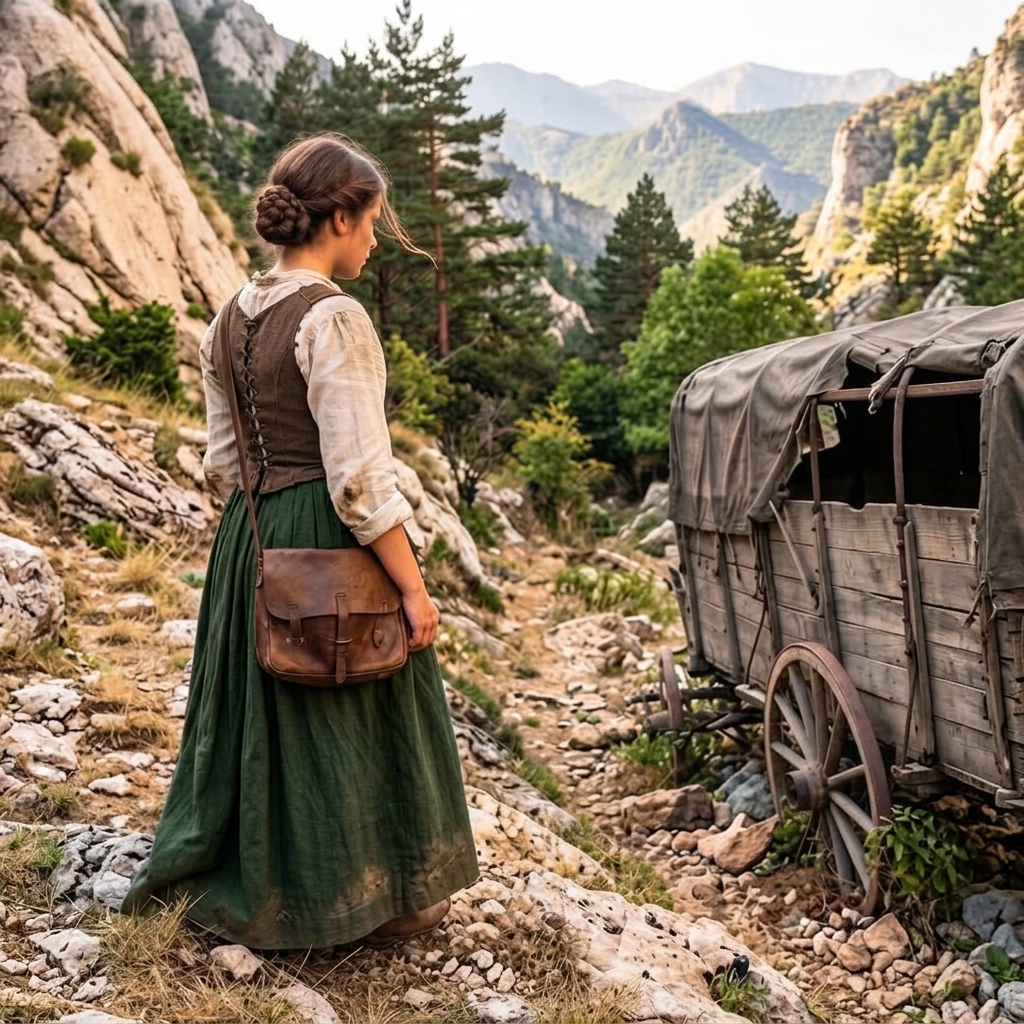
In a shallow ravine stood the remains of a carriage.
Not a wagon.
Not a farm cart.
A carriage.
Black wood faded almost gray.
One wheel leaned at an angle.
The roof had partially collapsed beneath years of snow.
Brass fittings were green with age.
A lantern bracket hung empty beside the driver’s seat.
The thing looked impossibly out of place.
Like someone had abandoned a nineteenth-century photograph in the middle of modern Colorado.
Claire moved closer.
A line of old stones beneath the carriage suggested there had once been a rough road.
Maybe mining country.
Maybe ranch access.
She knew parts of the San Juan Mountains were full of forgotten roads, cabins, tunnels, and ghost settlements.
Popular Posts
→- 1
- 2
- 3
- 4




Recently Viewed
Stories you read recently will appear here.


