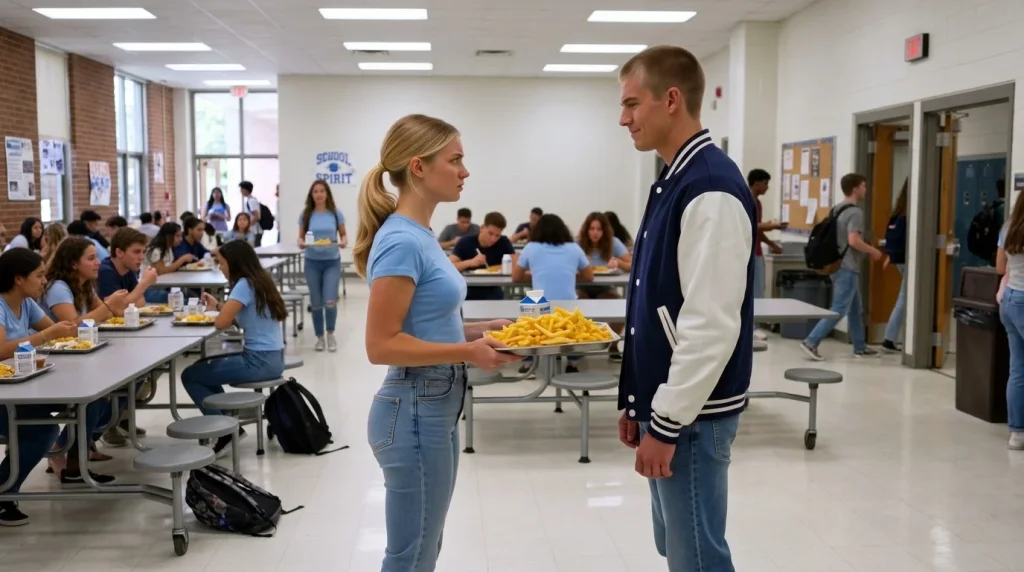
Part 1: The Hook, a Cruel Joke and a Long Walk
The opening of this clip is built on a gesture so small that it could happen in any school on any day. A girl carries a lunch tray, a boy swats it away, and food scatters across the floor. There is no visible argument and no buildup, only a casual act of cruelty delivered with a smirk. That is precisely what makes it effective. Viewers recognize the scene instantly, because most people have seen or experienced something like it, and recognition creates an emotional reaction before a single story element has been explained. In the first two seconds, the audience knows who is wronged, who is responsible, and who they want to see answer for it.
Over fifteen seconds,
the clip moves through five clear beats. The first is the setup and the swat, in which a tray is knocked from a girl’s hands. The second is the spill, a short burst of chaos as fries and burgers hit the tile. The third is her reaction, shown in tight close-ups that move from hurt to resolve. The fourth is the long walk of a man in a dark suit across a wide, empty floor. The fifth is the confrontation, in which the boy’s smirk vanishes as a hand takes hold of his jacket. Every beat is distinct, yet each one grows naturally out of the previous one, so the story flows without effort.
The most distinctive idea in the clip is the long walk. Rather than cutting directly from the humiliation to the consequence,
the film lets a figure in a suit cross a huge white cafeteria in real time, one measured step after another. The camera holds a wide, almost static view, and the audience watches him grow larger as he approaches. This is a classic suspense technique: show the threat approaching, and let the viewer’s anticipation do the work. Meanwhile the boy, who stands in the foreground with his attention elsewhere, has no idea. The gap between what we know and what he knows turns a quiet walk into the most tense stretch of the whole video.
The payoff arrives in the final close-ups. An older man with swept-back grey hair leans in close, his fist gripping the front of the boy’s varsity jacket, and the boy’s smirk drains away into wide-eyed alarm.
We never learn who the man is. He could be a teacher, a principal, a parent, or someone else entirely, and the clip does not need to say. His suit, his calm walk, and the sheer certainty of his posture communicate authority. The ambiguity is an invitation, and it helps the clip reach a wider audience, because every viewer can fill in the identity that best matches their own experience of school.
This blog breaks the clip down in ten parts, from the cafeteria and the costumes to each beat of the action, the editing, the AI craft, and the lessons creators can borrow. Read it as a field guide to telling a complete story in fifteen seconds.
Part 2: Setting and Cinematography
The setting is a large, modern school cafeteria,
and its design says as much as any character. The floor is glossy white tile that reflects the ceiling lights in soft streaks. The walls are blank and white, the lighting is bright and even, and rows of grey folding tables with attached round stools stretch into the distance. It is clean, spacious, and almost clinical. That sterility is powerful because it strips away every distraction. There are no posters, no decorations, no clutter, only the characters and the mess on the floor. The emptiness of the room makes the spilled food look louder, and the small act of cruelty feels exposed under the harsh light.
Color is used with great restraint. The environment is almost entirely white, grey, and pale blue, which makes the few warm colors stand out. Golden fries, orange-brown burgers, and a splash of white milk become the brightest objects in the frame when they hit the floor. The girl’s light blue top blends softly with the cool palette, which makes her look gentle and vulnerable, while the boy’s navy and white varsity jacket adds contrast and visual weight. Later, the man in the dark suit enters as a vertical stripe of charcoal and navy, the darkest thing in the room. His color alone tells us that something serious is approaching.
Popular Posts
→- 1
- 2
- 3
- 4




Recently Viewed
Stories you read recently will appear here.





