A Supply Sergeant Threw Her Bag Off The Truck—Then One Line In Her Orders Silenced The Depot
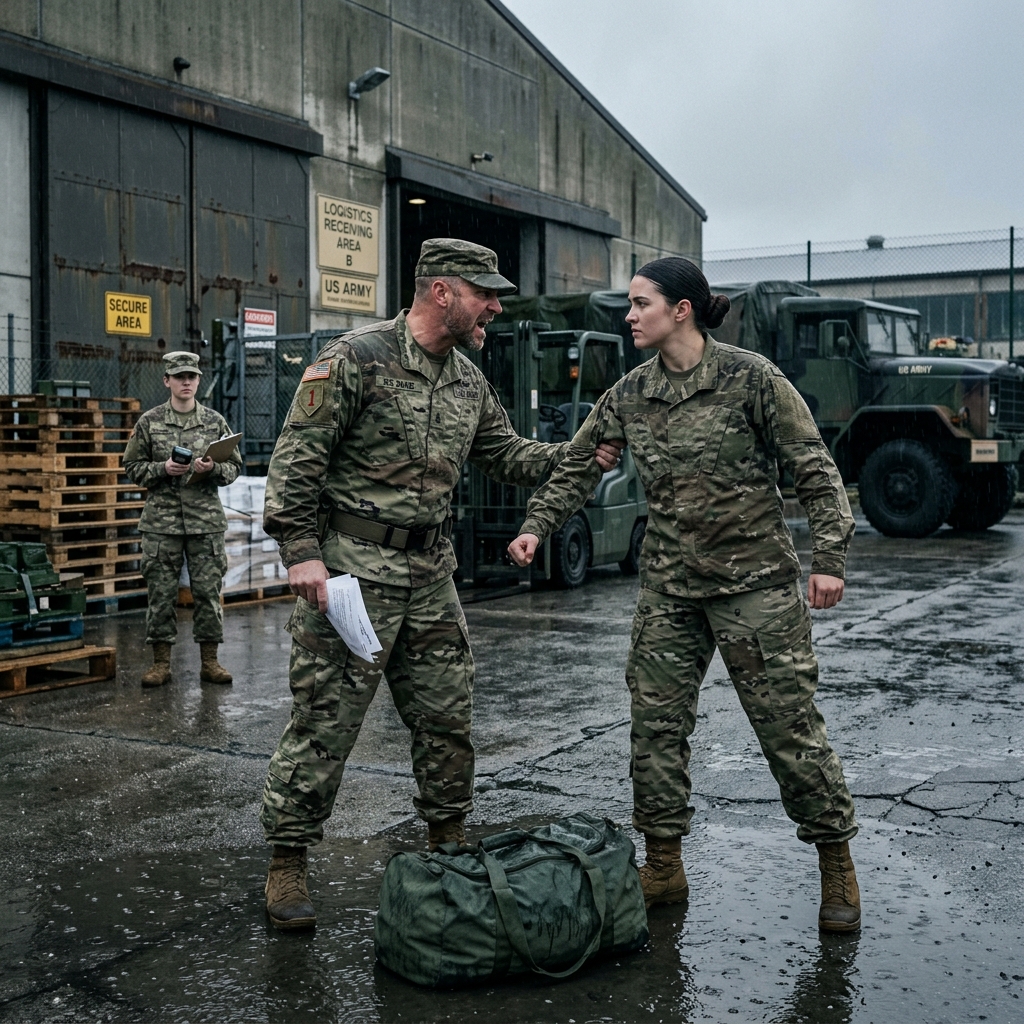
A supply sergeant dumped my duffel into a freezing puddle, called me “sweetheart,” and told an entire receiving yard that I was useless before I had even stepped off the truck. I let him laugh, because he had no idea why I had arrived without rank, a name tape, or an escort. For one full shift, I watched him expose everything he thought authority allowed him to hide. Then he grabbed my arm, ordered me off the installation, and demanded to see my paperwork.
### Part 1
“Bag off the truck, sweetheart. We don’t need you.”
Sergeant First Class Dale Hargrove said it casually, almost cheerfully, as if humiliating strangers before breakfast was one of the services his section provided. He leaned over the tailgate of the inbound supply truck, caught the strap of my weathered green duffel with one hand, and tossed it onto the concrete apron before I could reach for it. The bag landed in a shallow puddle left by the overnight rain, sending a thin sheet of dirty water over my boots while three soldiers near the loading dock tried not to laugh.
“Warm bodies wait outside the flow until somebody signs for them,” Hargrove continued. “That’s the system, and the system doesn’t have a line for you.”
I looked at my bag lying in the water, then at him. “Understood, Sergeant.”
That answer disappointed him more than anger would have. He had clearly expected an argument, a complaint, maybe a demand to speak to someone important, but I climbed down from the truck without hurry and stood on the cold concrete with my hands loose at my sides. My uniform was deliberately plain: operational camouflage, no visible rank, no name tape, no unit patch that would answer the questions he had not bothered asking.
The October morning at Fort Larkin had come up gray enough to make the central receiving yard look carved from steel. Container walls sweated with condensation, diesel fumes drifted beneath the long warehouse roof, and somewhere behind the stacked pallets a forklift kept giving its electronic warning beep as it backed through an aisle. Before Hargrove finished dismissing me, I had already noticed a blocked fire lane, a loose dock safety chain, two pallets carrying contradictory issue labels, and a hydraulic stain spreading beneath a material-handling vehicle that should not have been operating.
“Puddles seem about your speed,” Hargrove told me. “Find a chair. Stay out of my operation.”
A few soldiers laughed this time. One young private did not.
She was standing twenty feet away with a handheld scanner tucked against her chest, small and serious-looking beneath a patrol cap that seemed one size too large. Her name tape read COLLINS, and the stripes on her chest told me she had been in the Army long enough to know when a sergeant expected laughter but not long enough to have learned how to fake it convincingly. When she glanced at my duffel, I saw irritation cross her face before discipline erased it.
Hargrove pointed toward a folding chair beside a concrete support column. “There. Don’t touch anything with a document number.”
I sat down.
For the next forty minutes, I watched his yard tell me the truth.
A senior leader can tour a warehouse every week and never see what I saw from that folding chair. People clean when important boots are expected, supervisors straighten placards, broken equipment disappears behind locked doors, and everyone somehow remembers regulations fifteen minutes before the command group arrives. But nobody performs for a nameless woman who has just been called Puddle in front of the shift.
So I counted.
I counted how long a priority pallet sat untouched beside Receiving Lane Two. I counted every forklift forced to take the long route because Hargrove had allowed equipment to block the emergency lane. I watched one clerk sign a receipt without examining the temperature-monitoring strip attached to a shipment that required controlled storage, and I watched another soldier step over the same loose safety chain three times without securing it.
Numbers had always calmed me. Other people listened to music when they needed their minds quiet; I counted discrepancies.
At 0723, the yard stopped flowing.
Two supply clerks stood over a terminal, one pointing at a screen while the other searched a stack of paperwork with growing panic. A high-priority aviation requisition had hit their queue, but the system showed the required component on hand while the designated shelf was empty. Somewhere beyond our warehouse, an aircraft was sitting grounded because a part worth less than some pickup trucks had become more valuable than gold.
“Run the document history,” one clerk said.
“I did.”
“Then it isn’t here.”
“It says it is.”
“It isn’t.”
I waited another twenty seconds.
Popular Posts
→- 1
- 2
- 3
- 4




Recently Viewed
Stories you read recently will appear here.


