At A Family BBQ, My Sister-In-Law Slapped Me In Front Of My Kids. She Yelled, “You’re Not Even A Real Mother, You Just Adopted Them!” My Cheek Was Stinging, But My Navy Officer Training Kicked In. I Smiled Coldly And Gave Her Exactly Ten Seconds Before I…
### Part 1
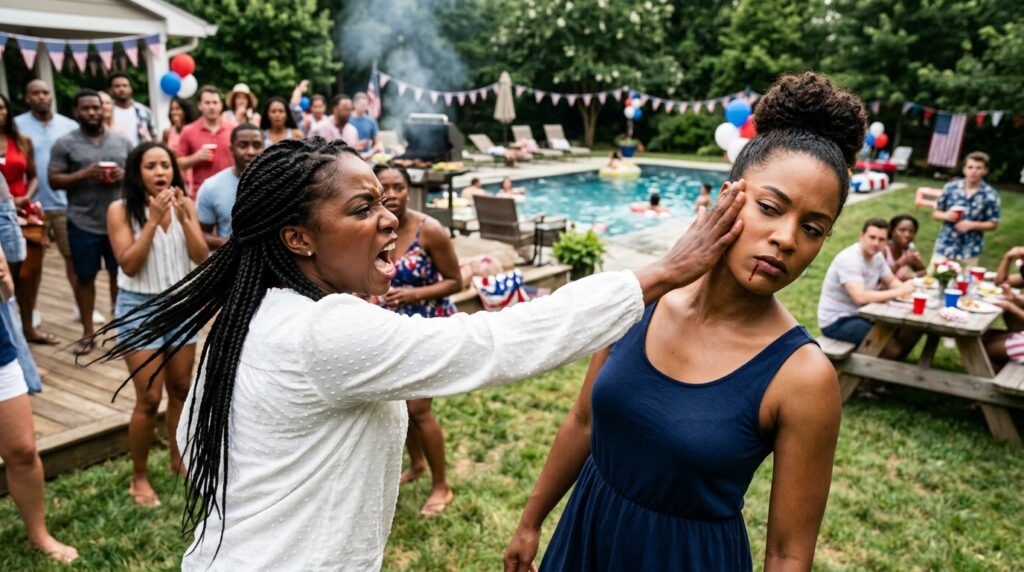
The slap landed before I saw Vanessa’s hand move.
One second, she was standing inches from me beside my parents’ swimming pool, her face twisted with rage and champagne on her breath. The next, a sharp crack split the backyard, my head snapped sideways, and the metallic taste of blood spread across my tongue.
The Fourth of July music stopped.
Someone dropped a pair of barbecue tongs near the grill. They struck the concrete with a hollow clatter that seemed unnaturally loud in the silence.
Behind me, my twelve-year-old daughter Maya gasped. Eight-year-old Lily began crying.
Vanessa stared at me with the wild satisfaction of someone who believed she had finally put an inferior person in her place.
“You’re not even a real mother,” she screamed. “You picked those girls up because you couldn’t have children of your own.”
The words reached my daughters before I could shield them.
Lily made a small, broken sound that I would hear in my sleep for months.
My husband, Michael, charged across the patio. Two of my Navy colleagues moved at the same time, their relaxed expressions disappearing as they recognized the shift in my posture.
I raised one hand.
Michael stopped.
I touched the corner of my mouth and looked at the smear of blood on my thumb. My cheek burned, but beneath the pain was something colder—something that had been waiting quietly inside me for years.
I looked Vanessa directly in the eyes.
“You have ten seconds to step away from me,” I said.
My voice was so low she leaned closer to hear it.
“After that, I’m calling the police and filing charges.”
Her confidence flickered.
Only for a second.
Then my older brother, Grant, pushed through the circle of stunned relatives. Sweat darkened the collar of his expensive summer shirt, though the afternoon wasn’t especially hot.
“Lauren, calm down,” he said. “Vanessa lost her temper. You frightened Connor. She was protecting her son.”
Connor, their fourteen-year-old, stood near the deep end of the pool with his head lowered. Five minutes earlier, Lily had run to me sobbing because he had called her and Maya “charity leftovers.”
He had also told them I was defective.
Those weren’t words a boy invented by himself. They were words he had heard at home.
“Protecting her son?” I asked.
Grant lowered his voice.
“Don’t make a scene.”
I almost laughed.
Vanessa had assaulted me in front of fifty guests, insulted my daughters, and shattered a wineglass against my parents’ patio, yet I was the one making a scene.
That was how my family worked. Grant could burn down a house, and my parents would criticize me for complaining about the smoke.
He had been the golden child since the day I was born.
When Grant turned eighteen, my father rented a jazz quartet, ordered a three-tier cake, and gave him the keys to a new midnight-blue car. Relatives raised crystal glasses while Dad called him “the future of the Bennett family.”
Two years later, on my eighteenth birthday, Mom handed me a drugstore card containing fifty dollars and reminded me not to expect anything extravagant because my birthday had fallen on a Tuesday.
There wasn’t a cake.
Grant’s college acceptance letter was still attached to the refrigerator with a gold magnet. During dinner, my parents discussed his future in finance while I ate reheated chicken beneath the buzzing kitchen light.
That night, I understood something that changed me permanently.
I wasn’t losing a competition with my brother.
I had never been entered into it.
The following Monday, I visited a Navy recruiting office. The room smelled like printer toner and burnt coffee. A recruiter with rough hands asked whether I understood the commitment I was making.
“I do,” I said.
I signed my name.
The Navy gave me what my family never had: standards that applied equally, consequences that couldn’t be negotiated over dessert, and respect that had to be earned.
I learned to run before sunrise in freezing rain. I learned to work calmly while alarms sounded and people around me panicked. Eventually, I moved into cyber operations, where a missed detail could affect thousands of people who would never know my name.
My parents called it a phase.
Grant called me a government employee with good posture.
Vanessa called me poor.
For years, I allowed them to believe it.
Standing beside that pool with my lip bleeding, I finally understood the cost of my silence.
Grant stepped closer and whispered, “We’re family. Let this go.”
I looked at the man whose house, children, and reputation rested on a secret known only to the two of us.
Then I smiled.
“Enjoy the next few days,” I told him.
The color drained from his face before I even turned away.
Popular Posts
→- 1
- 2
- 3
- 4




Recently Viewed
Stories you read recently will appear here.