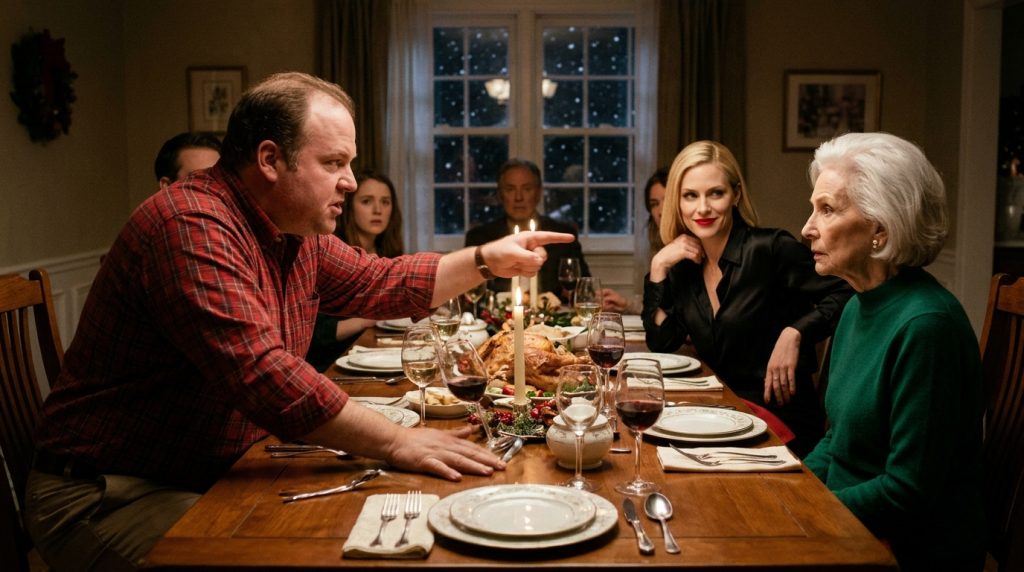
“That belief made me critical, demanding, and unkind.”
No one moved.
“I treated my daughter as though she were responsible for tragedies that happened before she was born and after she was born.”
My eyes filled.
Patricia looked directly at me.
“She was not responsible.”
Aunt Elaine lowered her head.
Patricia continued.
“I blamed her for my own choices.
I blamed her for being frightened.
I blamed her for needing comfort.
And at Christmas, I did the same thing to her daughter.”
She paused.
“I called Maisie a disappointment.
That was cruel.
It was wrong.
And I am sorry.”
The apology did not repair everything.
But it was the first time my mother had named the harm without adding a reason that softened her responsibility.
She did not say she had been misunderstood.
She did not say I was too sensitive.
She did not say she had been trying to help.
She simply told the truth.
When the gathering ended, Patricia did not approach me.
She waited near the doorway until I gave a small nod.
Then she came over.
“I do not expect you to forgive me today,” she said.
“I know.”
“I also know that saying sorry once does not prove anything.”
“No.”
“I will keep going to counseling.”
“Good.”
“I will tell you if I stop.”
“That matters.”
She looked toward the yard, where Maisie sat on a blanket beside Grant.
He was helping her stack soft rings on a wooden post.
“She is very strong,” Patricia said.
“She is.”
“I used to think strength meant never needing anyone.”
“What do you think now?”
Patricia’s gaze remained on her granddaughter.
“I think strength may mean telling the truth before fear turns it into something else.”
I looked at her.
“That sounds like something your counselor told you.”
“It is.”
“Do you believe it?”
“I am trying to.”
This time, the word did not sound like an excuse.
It sounded like a beginning.
Months passed.
Patricia kept her appointments.
She did not miss one.
She sent birthday cards to Maisie without asking whether I had shown them to her.
She stopped sending gifts that came with expectations.
When she wanted to ask about us, she asked Aunt Elaine whether I was open to hearing from her.
Sometimes I said no.
Sometimes I agreed to a brief phone call.
The conversations were awkward at first.
Patricia had to learn how to speak without correcting.
I had to learn how to answer without preparing for an attack.
Neither of us was graceful.
But we were honest.
When she made a mistake, she apologized.
When I became overwhelmed, I ended the conversation.
And each time, the world continued.
That was perhaps the strangest part.
Boundaries did not destroy the family.
They showed us which relationships could survive without control.
By spring, Patricia was allowed to visit.
Never alone.
Never without asking first.
The first time she came to our house, she stood in the entryway holding a small package wrapped in plain brown paper.
“What is it?” I asked.
“A book.”
“For Maisie?”
“For you.”
I opened it.
Inside was a blank journal with a blue cloth cover.
Patricia’s eyes lowered.
“I thought you might want to write your own version of things.”
I ran my fingers over the cover.
“I already have Grant’s records.”
“I know.”
She glanced toward him.
“Those helped you remember what happened.”
“Yes.”
“I thought you might need something for what happens next.”
The gift moved me more than I wanted it to.
“Thank you,” I said.
She nodded.
That afternoon, she sat on the floor while Maisie crawled between the cushions of the sofa.
She did not comment on her size.
She did not compare her to other babies.
When Maisie pulled herself upright using Patricia’s knee, my mother’s face filled with wonder.
“She is standing,” Patricia whispered.
“She has been practicing.”
Patricia looked at me.
“May I hold her?”
I considered the question.
Then I nodded.
She lifted Maisie carefully.
My daughter reached for the pearl necklace at Patricia’s throat.
This time, my mother did not pull away sharply.
She laughed and let Maisie touch one of the pearls.
“She has strong hands,” Patricia said.
“She does.”
“She will need them.”
I waited.
My mother looked at me.
“And she should never have to use them to protect herself from family.”
The room went quiet.
I felt something inside me loosen.
Not all the way.
But enough.
At Maisie’s first birthday, we held a small gathering at our home.
There were balloons in soft colors, a cake with strawberries, and a table covered with photographs from her first year.
Patricia arrived carrying a handmade album.
She gave it to me before entering the living room.
Popular Posts
→- 1
- 2
- 3
- 4




Recently Viewed
Stories you read recently will appear here.