I sat back in the rocking chair.
“I don’t know whether I feel brave or sick.”
“Both can be true.”
I looked at the journals.
“Does it ever stop feeling like I’m doing something wrong?”
Grant pulled the second chair closer.
“Not immediately.”
“How long does it take?”
“I don’t know.”
“Have you ever done this before?”
He considered the question.
“With your mother?”
“Yes.”
“No.”
“Then how do you know what to say?”
“I don’t.”
That answer comforted me more than certainty would have.
He took my hand.
“I only know that you are allowed to change your mind about what you can bear.”
The next morning, Patricia called twice before breakfast.
I did not answer either call.
By noon, three relatives had sent messages.
My cousin Lillian wrote that she hoped I was all right and that she had not known what to say during the gathering.
My uncle sent a shorter message.
He said family disagreements should remain private.
Then Aunt Elaine called.
I answered immediately.
“I’m glad you picked up,” she said.
Her voice sounded tired.
“Are you okay?”
“I’m not sure.”
“That makes two of us.”
I heard a kettle whistle in the background.
Elaine had always lived in a small brick house on the other side of Columbus, surrounded by maple trees and an unruly garden she refused to make more orderly.
Unlike Patricia, she never seemed troubled by anything that grew unevenly.
“How is Maisie?” she asked.
“She’s sleeping.”
“And you?”
“I’m trying to.”
“That is not what I asked.”
I gave a strained laugh.
“I know.”
Elaine was quiet for a moment.
Then she said, “Your mother told everyone you attacked her.”
“I did not attack her.”
“I know.”
“She said I embarrassed her.”
“She said you accused her of being a terrible mother.”
“I said she was blaming me.”
“That is not the same thing.”
“No.”
Elaine sighed.
“I should have spoken sooner.”
The sentence caught my attention.
“What do you mean?”
“At the house.”
“You did speak.”
“Not enough.”
“You told her to let us go.”
“I should have said more.”
I looked toward the window.
Snow had gathered along the sill.
“For thirty-four years, everyone has said not enough.”
“I know.”
“Why?”
She did not answer immediately.
When she finally spoke, her voice had changed.
It was softer, but not uncertain.
“Because your mother has always made people feel responsible for her feelings.”
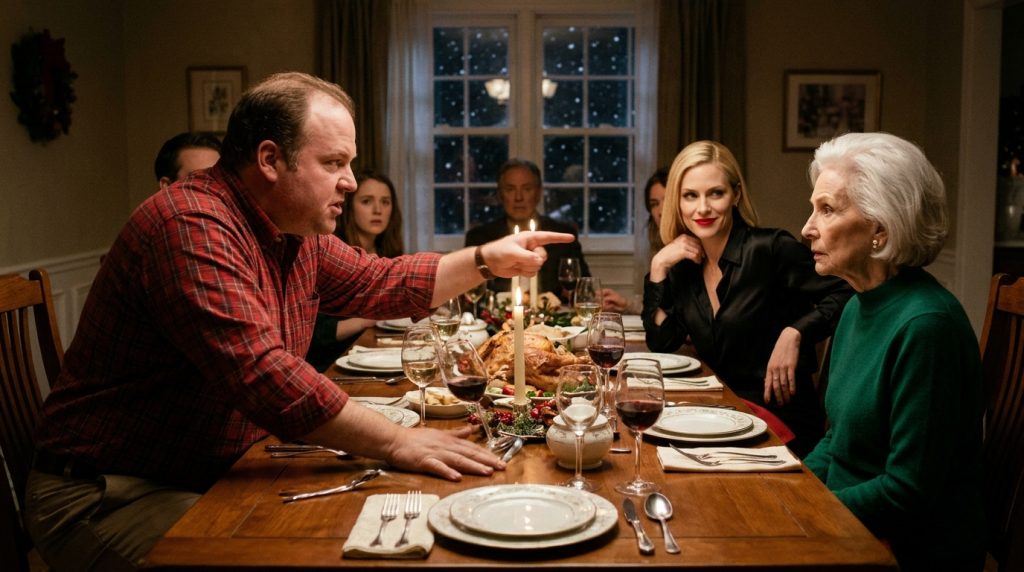
I thought of the room at Christmas.
The way everyone had gone still.
The way my mother had turned the focus from Maisie to herself within seconds.
“Did she do that when we were children?” I asked.
“Yes.”
“Did you see it?”
“Yes.”
“Then why did no one stop her?”
Elaine exhaled slowly.
“Because I was afraid of losing my sister.”
“And I was afraid of losing my mother.”
“I know.”
“Those are not the same thing.”
“No,” she said.
“They aren’t.”
The honesty in her voice unsettled me.
I had expected reassurance, perhaps a familiar explanation about how difficult Patricia had been under stress.
Instead, Elaine sounded as though she had been waiting years to admit that silence had consequences.
“Your mother was harder on you than she was on anyone else,” she continued.
“I know that too.”
“She told us you needed it.”
“Needed what?”
“Correction.”
I closed my eyes.
“She said you were too emotional, too careless, too eager for attention.”
My throat tightened.
“She told you those things?”
“She told everyone.”
“But no one believed her.”
“I believed some of it.”
That hurt more than I expected.
Elaine continued quickly.
“Not because it was true.”
“Then why?”
“Because she repeated it until it sounded like history.”
I thought about all the stories Patricia had told over the years.
How I had been difficult as a baby.
How I had cried too much.
How I had never been as responsible as my cousins.
How she had needed to keep me from becoming selfish.
The stories had always been presented as harmless family memories.
Now they felt like labels placed on me before I had been old enough to object.
“Elaine,” I said, “why are you telling me this now?”
“Because I saw your face yesterday.”
I looked down at my hands.
“You saw what she did.”
“I saw what it cost you to hear it.”
The kitchen seemed suddenly too quiet.
Then Elaine said, “There is something else you should know.”
I waited.
“Your mother was not at the hospital when you were born.”
I frowned.
“What hospital?”
“Riverside.”
“I was born at Riverside?”
“Yes.”
“I thought Mom was there.”
“That is what she told you.”
A cold feeling moved across my shoulders.
“What do you mean?”
“She told everyone she spent the night beside your crib.”
“She did.”
Popular Posts
→- 1
- 2
- 3
- 4




Recently Viewed
Stories you read recently will appear here.