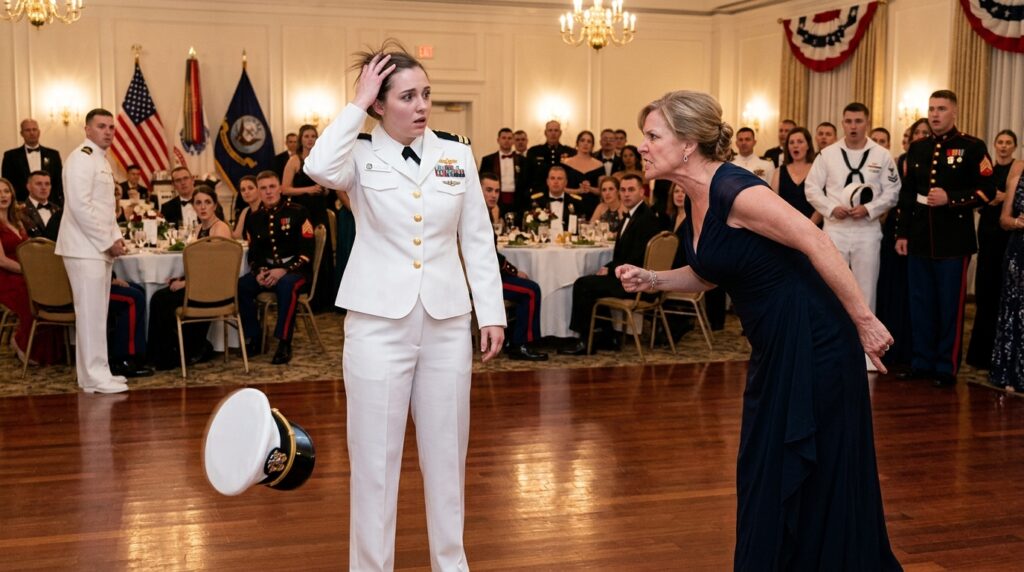
She Threw My Navy Cover to the Floor and Called Me a Fraud. Then an Admiral Opened a Burned Box From the Ship Where Her Son Died.
PART 1: THE COVER ON THE FLOOR
“Take that off.”
For a second, I thought Judith Mercer meant my coat.
Then her hand shot toward my head.
She ripped the white cover from my hair so hard that one of the pins at the back scraped my scalp.
The Navy Heritage Foundation band kept playing for one bewildered beat.
Trumpet.
Piano.
A brush against a snare drum.
Then my cover struck the polished ballroom floor, rolled beneath a cocktail table, and the music seemed to realize what had happened.
The room went quiet around us.
I didn’t move.
Judith stared at me as if she had finally caught me committing the crime she had suspected for years.
Behind her, Mark’s expression changed.
“Mom.”
He stepped between us.
“What are you doing?”
Judith ignored him.
I could feel the entire ballroom watching.
Senior officers.
Retired sailors.
Spouses.
Families.
Men and women who had served on ships whose names I knew better than some streets from my childhood.
I had walked into rooms under fire with less attention on me.
I hated that thought the moment it came.
This wasn’t combat.
This was family.
Sometimes family knew exactly where to aim.
I moved around the table, crouched, and reached beneath the white linen.
My cover had landed upside down beside the shoe of a retired captain.
He bent as if to help.
“I’ve got it,” I said softly.
My voice sounded normal.
That mattered to me more than it should have.
I picked it up.
There was a tiny gray speck on the brim.
I brushed it away.
My fingers were steady because I ordered them to be.
“Put it away,” Judith said behind me. “You’ve made your point.”
I straightened.
“I haven’t made any point.”
“That’s exactly the problem.”
She glanced around at the people watching us.
“You let people assume whatever suits you.”
Mark turned toward her.
“What is that supposed to mean?”
Judith’s eyes never left me.
The Navy Heritage Foundation’s annual dinner filled the grand ballroom of a Norfolk hotel every year. Usually it was a loud evening. Stories over bourbon. Reunion hugs. Old rivalries polished until they became jokes.
That night, at least around us, the noise had vanished.
I held my cover against my side.
“I came here as a guest,” I said. “I’d like to keep this private.”
“Private?”
Judith almost smiled.
“You walked into a room full of sailors dressed like one.”
Mark’s shoulders tightened.
“She is one.”
The words landed in the silence.
Judith looked at my uniform again.
She studied the white coat first.
Then the shoulder boards.
Then the rows of ribbons.
Finally her gaze stopped on the gold warfare insignia above them.
I knew that look.
I had seen it at Thanksgiving when she asked which ships I had served aboard.
At Christmas when she asked where exactly I had been deployed.
At Andrew’s memorial dinner when she wanted to know whether I had ever been “close to real combat.”
Every time, I had answered what I could.
Every time, she had heard only the part I did not say.
“You translate reports for real sailors,” she said.
I felt Mark flinch.
Judith continued.
“That doesn’t make you one of them.”
A man near the bar slowly lowered his glass.
Two women beside him exchanged a glance.
Mark said, “She’s a Navy commander.”
Judith gave a short laugh.
“Because she says so?”
Something cold moved through me.
Not anger yet.
Something older.
I had spent years learning that there were moments when anger cost more than silence.
I lifted the cover and settled it back on my head.
I adjusted it once.
Exactly once.
Then I lowered my hands.
“I’ve never lied to you about my work.”
“You told me you were in intelligence.”
“I am.”
“You told me you analyzed languages.”
“That was part of my job.”
Judith pointed at my ribbons.
“You left all of this out.”
That hurt more than having my cover thrown to the floor.
Because she believed it.
She genuinely believed that every classified answer, every redirected question, every careful sentence had been a personal deception.
For years I had been protecting information.
I had also been protecting her.
The second truth was harder to admit.
“I can explain what’s appropriate,” I said. “We can talk somewhere else.”
“Somewhere without witnesses?”
“That isn’t what I said.”
“It’s what you want.”
Mark looked over his shoulder.
More guests had turned.
At the far side of the ballroom, one of the servers stood motionless with a tray of champagne flutes.
Judith saw the audience.
Instead of shrinking from it, she stood straighter.
That frightened me more than her anger.
“Elise shouldn’t have to defend her uniform to you,” Mark said quietly.
Popular Posts
→- 1
- 2
- 3
- 4




Recently Viewed
Stories you read recently will appear here.


