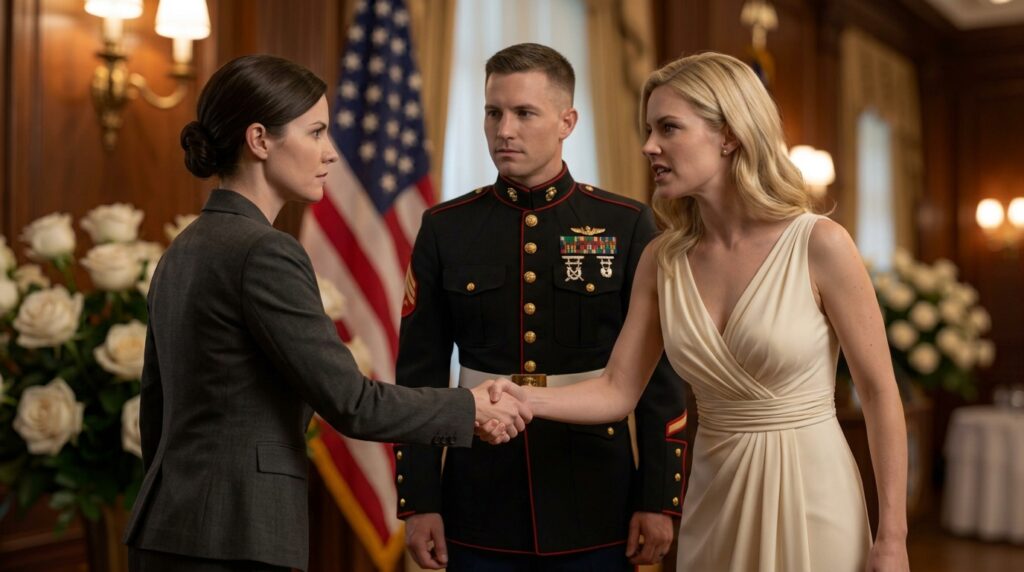
My Sister Blocked Me From Shaking Her Fiancé’s Hand And Said, “A Drill Desk Worker Doesn’t Belong Near Combat Heroes!” Her In-Laws Nodded In Arrogant Agreement. Her Husband-To-Be Glanced At The Pin Concealed On My Blazer. His Jaw Dropped, And His Knees Buckled. “Phantom…? The Special Operations Commandant?!” He Stood At Stiff Attention Before The Entire Room And Said, “Ma’am, Permission To Be Excused For Her Disrespect.” My Sister’s Face Drained Of All Color.
My sister spent ten years telling everyone I was the disappointing daughter who filed records in a government basement while she surrounded herself with decorated officers and powerful families. At her engagement dinner, she slapped my hand away from her fiancé and announced, “Don’t touch an elite officer with your civilian hands.” I was ready to leave without defending myself—until the ballroom doors opened, a two-star general walked straight past her, and the man she planned to marry suddenly recognized the dull brass pin hidden beneath my jacket.
### Part 1
The first thing my sister Brooke did when I arrived at her engagement dinner was move my place card closer to the kitchen.
She didn’t even say hello first. She stood beside the seating chart in a cream-colored dress that probably cost more than my first car, plucked the ivory card marked MORGAN HALE from a table near our mother, and carried it across the ballroom as if she had discovered something unsanitary. “This will be better,” she said, sliding it between an elderly cousin I barely knew and the swinging doors where servers kept appearing with trays of champagne.
I looked at the new seat, then back at her. “Better for whom?”
“For everyone.” Brooke smiled without warmth and smoothed the front of my charcoal blazer with two fingers. “Evan’s family is military royalty, Morgan. Tonight isn’t the night for stories about records management, supply forms, or whatever you do in Washington.”
The officer’s club smelled of polished wood, white roses, butter, and the faint metallic chill of air-conditioning turned several degrees too cold for evening gowns. American flags stood beside the small stage, and photographs of former commanders lined the paneled walls beneath brass lamps. Somewhere near the bar, a pianist was playing a softened version of an old jazz standard while Brooke’s future father-in-law shook hands like he was working a receiving line.
I glanced toward Captain Evan Mercer, Brooke’s fiancé, standing near the head table in his dress uniform. He was broad-shouldered, controlled, and visibly uncomfortable as Brooke moved my name card, but he said nothing. That told me something about him I filed away without judgment.
“You invited me,” I reminded her.
“Mom invited you.” Brooke leaned closer. “I tolerated it.”
Before I could answer, our mother appeared behind me carrying a champagne flute she had barely touched. Elaine Hale looked elegant in navy silk, her silver-blond hair pinned precisely at the nape of her neck, but the expression she gave my blazer was the same one she used when she discovered a stain on good furniture. “Morgan, couldn’t you have worn something softer?”
“I like this.”
“You always like practical things.” She tugged unnecessarily at my lapel, and for half a second the fabric shifted enough to expose the edge of the dull brass pin underneath. “Brooke’s marrying into a very traditional military family. Please don’t turn tonight into one of your strange little statements.”
I covered the pin naturally and looked toward the windows. Ten years of federal service had taught me the value of letting silence do work that words usually ruined. Unfortunately, my family had always interpreted silence as proof that they had correctly understood me.
As far as they knew, I handled military records in Washington.
That story had started years earlier because it was close enough to the truth to be useful. I had entered federal service after graduate school, disappeared into a series of increasingly restricted assignments, and learned very quickly that the safest answer to family questions was, “Mostly administrative work.” My mother translated that into filing, Brooke translated it into failure, and neither of them ever seemed curious enough to ask again.
I preferred it that way.
My actual work rarely fit into simple sentences. I spent more nights than I cared to count in secure rooms where clocks showed five time zones, coordinating people, aircraft, routes, intelligence updates, and contingency plans that changed before coffee had time to cool. I had learned to sleep sitting upright, to eat without tasting anything, and to recognize bad news from the way a door opened.
None of those things belonged at my sister’s engagement party.
Popular Posts
→- 1
- 2
- 3
- 4




Recently Viewed
Stories you read recently will appear here.


