Part 1:
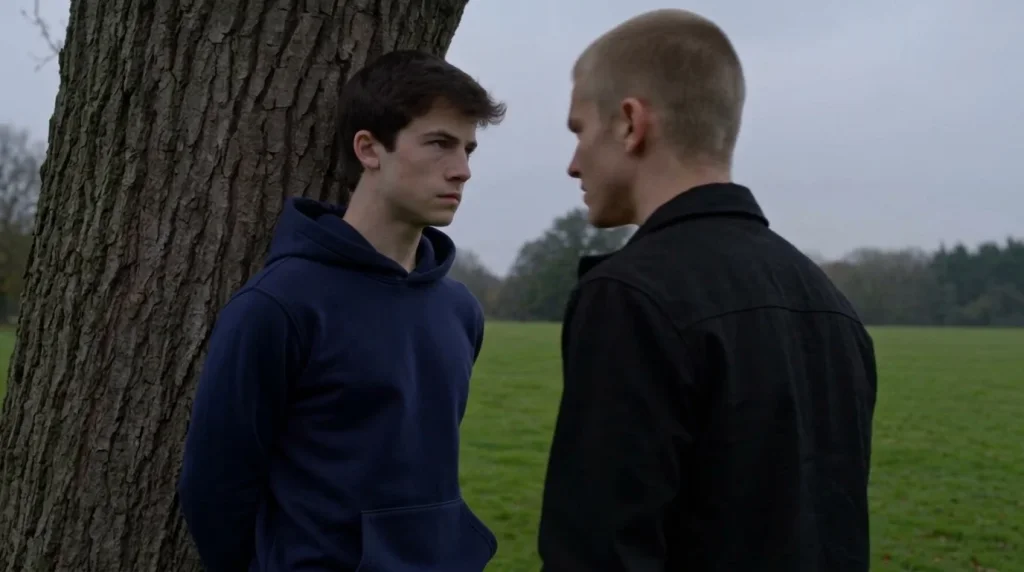
Short-form video has trained audiences to expect instant payoff: a punchline, a transformation, a dramatic reveal. The clip analyzed here does something quieter and far more uncomfortable. In just over fifteen seconds of vertical footage, shot in a 1080 by 1920 frame built for phones, it presents a complete dramatic situation. A young man in a navy hoodie is bound at the wrists behind an old tree, a harsher figure in a black jacket confronts him at close range, and a handful of onlookers watch from the grass. Nothing is resolved. Nothing is explained. The video simply asks the viewer to sit inside the tension for a moment longer than is comfortable.
A small but important detail runs along the bottom edge of the frame throughout the clip: a line of text stating that this is an AI-generated fictional story,
made for entertainment purposes only, with no offense or disrespect intended. That label reframes everything. We are not watching documentary evidence or a real incident, but a constructed piece of visual fiction, assembled with generative tools and shaped by a creator who chose very specific images to carry the emotional weight. As an analyst, I consider that the first thing worth noting, because it signals responsible practice in a medium where realistic fakes can easily be mistaken for reality.
This breakdown is based on the visual content of the video: its framing, color, movement, character design and sequencing. It follows the story as it unfolds second by second, from the opening macro shot of rope and knuckles to the closing wide shot of two figures locked in a stare while a small group watches behind them.
Across ten parts, we will examine the hands, the characters, the color symbolism, the camera language, the role of the bystanders, and the creative and ethical questions raised by AI-generated storytelling.
Why spend five thousand words on fifteen seconds? Because compressed stories reveal how much meaning a single frame can carry. Every decision here, from the coarse texture of the rope to the bright yellow of a distant raincoat, is doing narrative work. By slowing down and looking closely, we can understand not only what this particular video communicates, but why it is likely to stop thumbs mid-scroll, provoke heated comments, and linger in memory long after it ends. Let us begin where the video itself begins: with a pair of hands.
Part 2: The Opening Shot: Rope, Knuckles and the Language of Restraint
The video opens without any establishing context.
There is no wide shot, no landscape, no face. Instead we receive an extreme close-up of hands: one pair, bound and held behind a thick tree trunk, while another pair works at the rope, pulling and tightening. The skin tones, the dark sleeves, the rough bark and the soft blur of green grass behind them create a dense, tactile image. Within the first second we already understand the premise through touch rather than explanation. Someone is being restrained, and someone else is doing the restraining.
Notice how the rope itself is presented. It is thick, fibrous, the color of dry straw, and knotted in a layered, deliberate pattern rather than a casual loop. Over the next two seconds the camera holds on that knot as it settles into place, giving the viewer time to register that this is not a spontaneous shove or a playground argument.
It is an act that took effort and intention. Macro framing like this is a classic technique for making an object feel heavy with consequence, and the shallow depth of field keeps the bark and fingers sharp while the rest of the world dissolves into softness.
The bound hands themselves tell a story. In the early shots they are open and slightly curled, passive, almost vulnerable. Later in the video, the same hands return as clenched fists straining against the knot. That change is the emotional arc of the entire clip compressed into a single part of the body: from helplessness to defiance. The editor understands that hands are expressive, and that audiences read emotion in knuckles and fingers almost as quickly as in faces. By withholding the protagonist’s face for the first few seconds, the creator invites us to feel the restraint physically before we understand it socially.
Popular Posts
→- 1
- 2
- 3
- 4




Recently Viewed
Stories you read recently will appear here.





