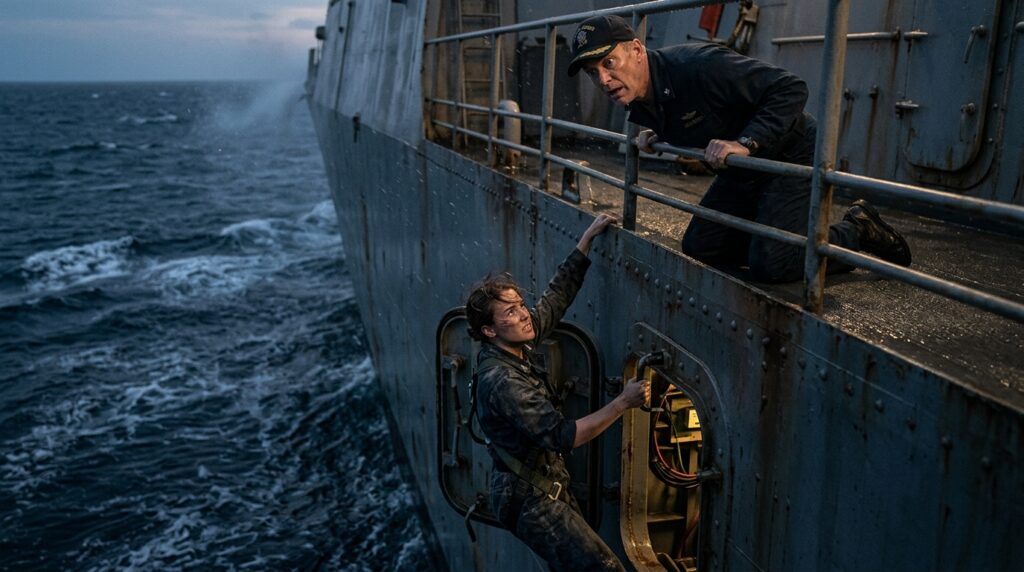
Colonel Victor Kane made one mistake when he kicked Hannah Mercer Cole over the rail of the USNS Resolute.
He assumed she had come aboard alone.
The instant Hannah’s boots left the steel deck, the world became blue sky, gray hull, and roaring Pacific. Her shoulder struck the side of the ship hard enough to numb her arm, but her left hand found the exterior maintenance ladder exactly where the engineering diagram said it would be.
She caught it.
Above her, boots pounded across the deck.
Someone shouted.
The ship’s alarm began to scream.
Hannah hung thirty feet above the water, one arm wrapped around a steel rung, while the Resolute continued cutting through the ocean.
Then she heard Kane.
“Problem taken care of.”
Even after everything, he still sounded calm.
That was Kane’s talent.
He could make cruelty sound like procedure.
For six weeks, NCIS had been trying to determine how cargo connected to a classified naval recovery program had vanished without leaving the Resolute.
According to official records, twelve sealed cylinders had been unloaded during a resupply stop on a remote Pacific island.
Port records showed the shipment arriving.
The Resolute’s cargo manifest showed the shipment leaving the ship.
A warehouse supervisor had signed for it.
Every document matched.
Except for one problem.
The warehouse had never received the cylinders.
The supervisor whose electronic signature appeared on the transfer had been hospitalized after a motorcycle crash three days before the Resolute reached port.
Someone had used his credentials while he was unconscious.
At first, investigators suspected stolen military hardware.
Then a civilian logistics analyst named Owen Beck contacted NCIS.
Beck had worked aboard the Resolute for nearly four years. Quiet, methodical, forgettable to most officers, he spent his days comparing fuel, maintenance, and cargo records.
He had noticed something strange.
After the supposedly unloaded shipment disappeared from the manifest, the Resolute’s electrical consumption increased.
Not much.
Just enough to power additional ventilation, refrigeration, and water circulation somewhere aboard the ship.
The demand continued for six weeks.
Beck searched the vessel schematics.
There was no compartment listed where that equipment should have been operating.
Three days later, he disappeared.
His cabin was empty.
His personal bag remained under his bunk.
His passport remained locked in the ship’s administrative safe.
Colonel Victor Kane reported that Beck had voluntarily disembarked during the same island stop.
That claim should have ended the matter.
Instead, it made Hannah suspicious.
Because security footage showed Beck walking aboard the Resolute after the ship had already left the island.
The video lasted only four seconds.
It was the last confirmed image of him alive.
Hannah had been sent aboard under an ordinary service assignment with one objective: find the compartment Beck had discovered.
Nobody aboard was supposed to know she was investigating.
Not the captain.
Not the Marines.
Not even the ship’s security section.
Only Hannah, her NCIS case officer, and a four-person response team waiting beyond visual range knew the operation existed.
For the first two days, Hannah found nothing.
Kane barely acknowledged her.
On the third day, however, she noticed that Deck Four was warmer than Deck Three despite being closer to the waterline.
On the fourth, a maintenance technician mentioned that Kane personally approved every work order involving the aft ventilation system.
On the fifth, Hannah found a section of fresh welding hidden behind a utility panel.
Then Kane started watching her.
By the seventh afternoon, the temperature on deck had climbed brutally high.
Three sailors collapsed during formation.
Emergency water was stored below deck, but Kane refused to release it until the scheduled exercise ended.
When a young signalman named Tyler Grant fell beside Hannah, his knees folding beneath him, she stepped out of formation.
“Sir, he needs water.”
Kane looked at her as though she had challenged his authority in front of the entire ship.
Hannah knelt and loosened Grant’s collar.
Kane ordered her to stand.
She refused until another sailor was allowed to carry Grant into the shade.
That should have been a minor disciplinary argument.
Instead, Kane announced an unauthorized open-water “confidence test.”
Hannah understood immediately.
This was not punishment.
Kane wanted her near the stern.
He had decided she knew too much.
When she refused to participate, Kane walked toward her with five hundred sailors and Marines watching.
He demanded an apology.
Hannah looked past him at the stern rail.
Beneath it was the maintenance hatch she had spent a week trying to reach without being seen.
She finally understood why Kane had chosen that location.
He believed the ocean would destroy the problem for him.
She also understood something Kane did not.
The waterproof evidence key hidden inside her sleeve had been cut that morning from measurements Owen Beck had secretly uploaded before he vanished.
So when Kane drove his boot into her chest and sent her over the rail, Hannah did not fall blindly.
Popular Posts
→- 1
- 2
- 3
- 4




Recently Viewed
Stories you read recently will appear here.


