Evelyn received a sentence reflecting both financial and obstruction conduct, while the assault added separate conditions and restitution.
Not life-destroying.
Not symbolic.
Real.
After court, Michael and Claire finally spoke.
He said:
“I’m sorry she did that to you.”
Claire answered:
“I’m sorry she erased you.”
They both laughed awkwardly at the symmetry.
Neither injury made them equivalent.
Both recognized the other.
That became the beginning of their friendship.
Evelyn later wrote from prison asking Michael to visit.
He declined through counsel.
She asked Logan.
He waited six months, then went once.
Claire did not object.
His mother was his relationship to manage.
But she set one boundary:
“Do not bring messages back to me.”
Logan agreed.
He kept it.
That mattered more than whether the visit itself was right or wrong.
During Evelyn’s imprisonment, Diane—one of the older Blackwood cousins who had stayed silent for years—sent Claire a packet of letters showing that Anne had once tried to reopen contact through the family attorney.
The letters were returned.
Not by Charles.
By Evelyn.
One envelope had handwritten instructions:
DO NOT FORWARD.
Claire did not need the letters to prove criminal conduct.
They mattered emotionally.
Evelyn had not merely failed to reach out.
She had actively intercepted attempts.
Michael read them once.
Then placed them with his own attorney.
He refused to keep originals at home.
“I don’t need paper proving she didn’t choose me.”
That sentence stayed with Claire.
Evidence can become obsessive if people keep rereading it for emotional certainty.
The fact existed.
He did not need to reopen the wound every week.
Logan struggled more.
He wanted to understand his mother’s psychology.
Michael did not.
Different needs.
Claire encouraged neither to demand the other’s method.
Family recovery stopped requiring consensus.
Evelyn’s letters from prison reflected uneven insight.
Some apologized.
Some blamed Charles.
Some blamed Anne.
One said:
I was afraid if Michael came back, I would lose Logan too.
Logan read that line and finally understood the zero-sum thinking beneath his childhood.
His mother believed love had finite seats.
One child’s return threatened another’s place.
That belief shaped everything.
Claire had experienced the same structure as daughter-in-law.
Her belonging threatened Evelyn’s control over Logan.
So Evelyn humiliated her.
Same mechanism across decades.
Scarcity of love manufactured into hierarchy.
Logan brought that insight to therapy.
His counselor asked:
“Do you want to spend your life proving everyone has a seat?”
Logan said:
“No.”
“Then stop organizing relationships like a table chart.”
That metaphor became useful.
No ranking.
No head seat.
No one person deciding who belongs.
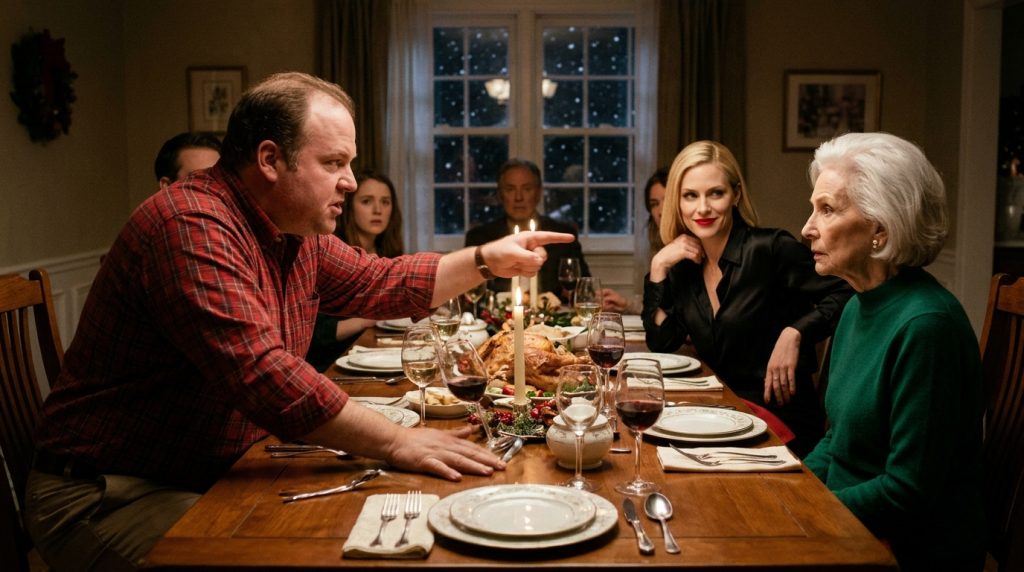
Later, when Logan and Claire hosted Thanksgiving again, they used two ordinary tables pushed together because the dining room was small.
No head.
May you like
Nobody noticed.
Claire did.
Chapter 7 – LOGAN CHOOSES
Popular Posts
→- 1
- 2
- 3
- 4




Recently Viewed
Stories you read recently will appear here.