Part 2: Bank records reveal what politeness had been hiding
The bank representative spoke in the calm, careful tone people use when they know the person on the other end is trying not to become angry. After verifying my information, she explained that a replacement card had been requested seven months earlier through the online account. The mailing address had not changed, which meant the envelope had come directly to my house.
“Who activated it?” I asked.
She paused while typing. “It appears the activation was completed online.”
“Can you tell me from whose device?”
“Not from what I can see, ma’am.”
I looked toward the hallway. Daniel and Mallory had used my desktop computer several times when their laptop stopped working.
I canceled the card immediately, changed every password attached to the account,
and asked the bank to send me documentation of the disputed transactions. Then I called Harriet Cole, the attorney who had handled my mother’s estate and later helped me prepare my own will. I expected Harriet to tell me I was overreacting. Instead, she asked three precise questions: Was the house solely mine? Yes. Had I given Mallory permission to use the account? No. Did I want Mallory prosecuted, or did I want the financial access stopped and my household boundaries restored?
That last question sat differently.
“I want my life back,” I said.
“Then start there.”
I spent the next hour gathering papers. I put the bank statements on the kitchen table, highlighted every questionable charge, and placed the canceled card beside them. Then I wrote a short note in my own handwriting: Mallory,
this card has been canceled. I have documentation of charges I did not authorize. We will discuss this with Daniel tonight. Until then, do not attempt to access any of my financial accounts.
I almost removed the note twice.
The first time, I imagined Daniel defending his wife and accusing me of turning a family misunderstanding into a financial investigation. The second time, I pictured Mallory crying, and I hated myself for how easily that possibility could still make me retreat. Then I looked toward the staircase and remembered the laundry basket waiting upstairs.
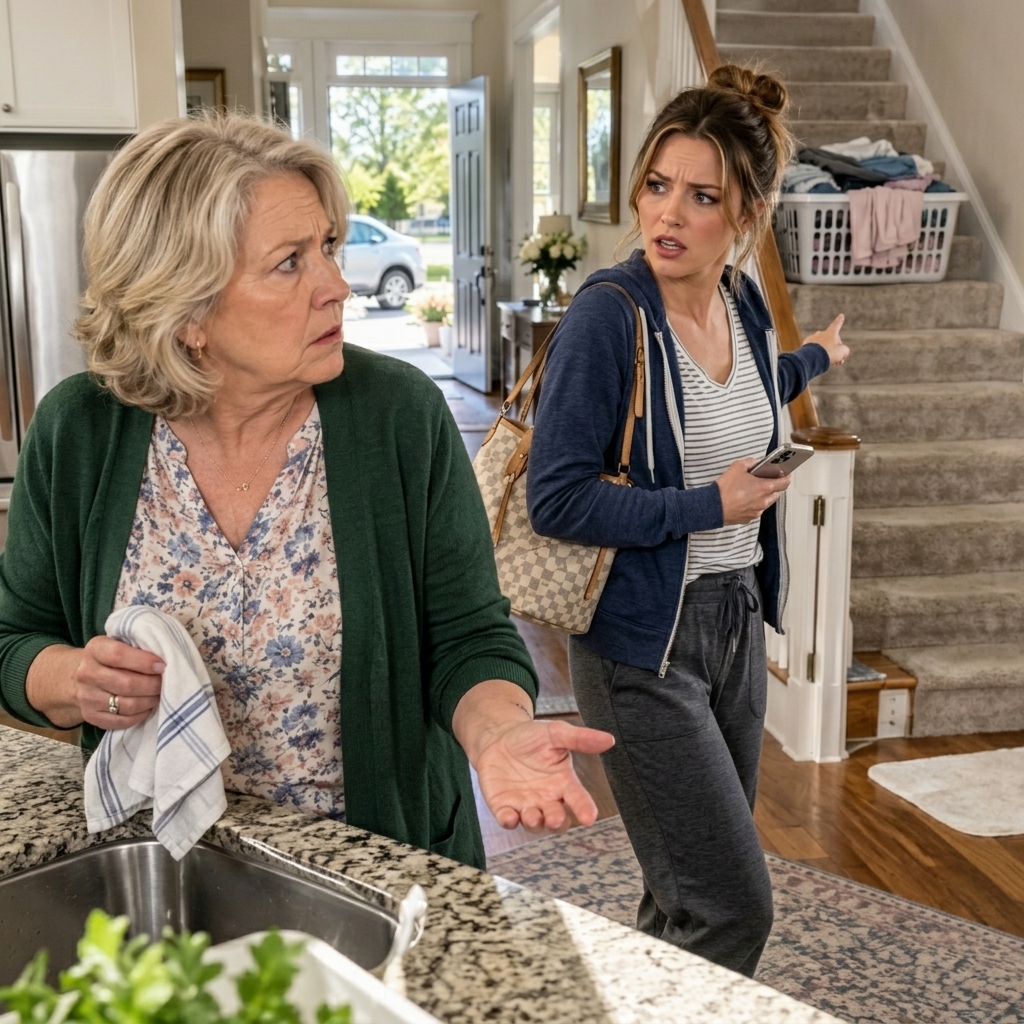
At four-thirty, a car door slammed outside. Mallory entered carrying two glossy shopping bags and talking over her shoulder to Paige about dinner reservations. “I’ll text you,” she called, then shut the door and noticed me sitting near the window.
Her smile faded when she saw the table.
“What’s all this?”
“You should read it.”
She picked up the first statement. Her eyes moved quickly across the yellow highlights, then more slowly. “Evelyn, these are household expenses.”
“Willow House Spa is a household expense?”
Mallory pressed her lips together. “Some of those charges were mine.”
“All of them were.”
“You don’t know that.”
“I called the bank.”
That was when she finally put the papers down.
She sat across from me and lowered her voice. “Okay. I used the card sometimes. But I thought Daniel had talked to you.”
“He hadn’t.”
“He told me you said we could use what we needed while we were here.”
“For groceries and utilities, Mallory. Not facials.”
Her cheeks reddened. “You make it sound disgusting.”
“I’m describing where the money went.”
She reached for her phone.
“Calling Daniel?” I asked.
“Yes, because this is getting completely out of proportion.”
Twenty-five minutes later, my son came through the front door still wearing his work boots.Part 3: My son finally sees the cost of staying neutral
Daniel took one look at Mallory, one look at me, and then pulled out a chair. “Nobody yell,” he said.
“I haven’t,” I answered.
Mallory let out a sharp breath. “Your mother thinks I stole from her.”
Daniel’s forehead creased. “Did you use her card?”
“She wasn’t using it.”
The words landed harder than any shouting could have.
Daniel turned toward her. “That wasn’t my question.”
Mallory looked at the table.
I slid the statements toward him and let him read. Daniel had always been careful with money, mostly because we had once had so little of it. When he was twelve, he knew which grocery store marked down meat on Thursday evenings. When he was sixteen, he worked weekends at a hardware store because he wanted basketball shoes I could not afford. Watching him calculate those charges was like watching somebody recognize a language he wished he had forgotten.
“Eleven hundred and forty-three dollars,” he said.
Mallory wrapped both hands around her phone. “Over months.”
“That doesn’t make it smaller.”
“I was going to put it back.”
“With what?”
She looked at him then, wounded anger rising in her face. “Do you have any idea what it feels like to have to ask you before I buy shampoo?”
“I never made you ask me for shampoo.”
Popular Posts
→- 1
- 2
- 3
- 4




Recently Viewed
Stories you read recently will appear here.


