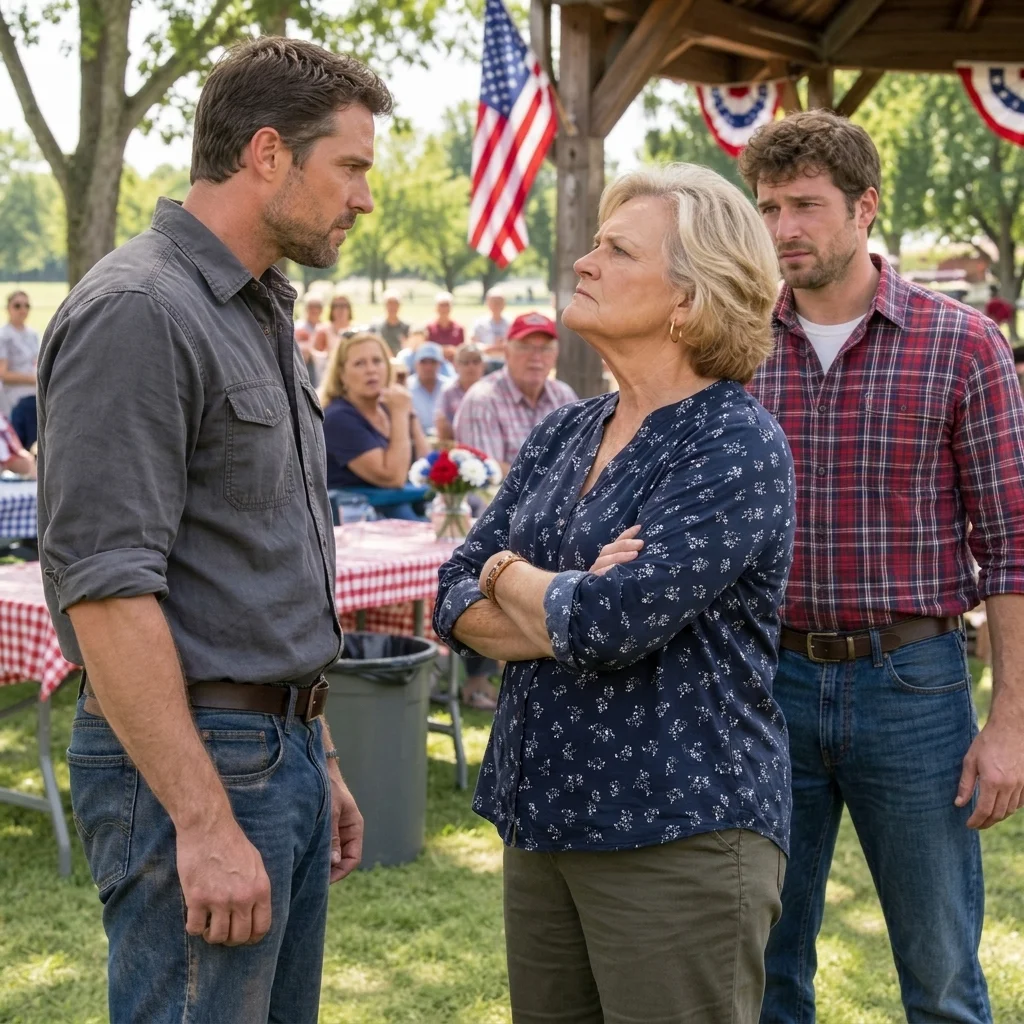
Six months after my mom signed the family farm over to my little brother, she stood at the co-op parts counter begging me to fix his two dead irrigation pivots with my own spare parts, on credit. The corn was already dying, and she told me that if I didn’t have both pivots running by Friday, I wasn’t her son anymore.
My name is Mason Kroger. I’m thirty-eight years old, and I run Kroger Pivot Service out of one truck. I’ve been on the road since 2011, repairing Valley, Zimmatic, and Reinke irrigation pivots across four counties in Nebraska.
Here’s the part my family never thought mattered. I kept the only rebuilt parts inventory in those four counties: fourteen wheel gearboxes and two center-drive motors. Every one of them had a yellow stripe painted on it and a number stamped into the housing.
Every one was recorded in my rebuild binder, in my own handwriting, along with the date I’d put it back together.
I bought those parts with my own money and rebuilt them with my own hands. The strange thing was that the shed where I stored them didn’t even belong to me. Dad’s will had left Roger’s machine shed to Mom and the shop tools to me. But a man’s gearboxes are his gearboxes, no matter whose roof they’re under. I’d always figured that was plain enough.
Apparently, it wasn’t.
To understand what happened at that parts counter, you have to go back to January 1st. Mom called me over to the house on a Saturday. When I walked into the kitchen, she had papers spread across the table. She’d signed the entire 240-acre home farm over to my younger brother,
Lance, including the machine shed.
Lance was thirty-four, four years younger than me. He’d stayed home to farm while I’d gone out on my own. Mom stood beside the kitchen table with the pen still in her hand and said something I’ll never forget.
“Lance stayed and farmed. You left to fix other men’s sprinklers.”
I didn’t argue. I just asked whether there was anything in the arrangement for me.
“The tools are already yours,” she said.
As far as she was concerned, that settled everything. She went back to drinking her coffee while I stood there looking at the papers.
That was January. By April, Lance had sold every gearbox and both motors out of that shed to a salvage buyer for $6,500.
I didn’t know that yet.
What I knew in January was that this wasn’t the first time my family had decided something of mine belonged to someone else. The pattern went back a long way.
In 2002, when I was fifteen, I spent an entire summer detasseling corn. I came home with a check for $1,900, money I’d earned working in the fields. Lance needed feed money for his 4-H steer, and somehow my entire check ended up paying for that animal.
Then, in 2013, I had $5,000 saved toward buying a truck. Mom borrowed it to cover the farm’s fuel bill. I never saw a dollar of it again, and she never mentioned the loan afterward.
That’s why I started protecting myself. I opened a separate bank account, kept a receipt for everything,
and painted my own identification numbers on every part I rebuilt.
Not because I’m cold. Because I’d learned that nobody in my family was going to keep score for me.
Which brings me back to the co-op counter.
It was Thursday, July 3rd, 104 degrees in Holdridge, and I was picking up a seal kit when I heard my mother’s voice behind me. She was sixty-seven, standing there with her purse clutched in both hands. She didn’t even bother saying hello.
“Mason, I need those spare parts of yours. Both of Lance’s pivots are down, and there’s corn burning. You can bill us after harvest.”
I set the seal kit on the counter.
“No.”
Her face went red all the way to her ears.
“Excuse me?”
“You’re asking for $1,400 worth of parts and about two weeks of labor on credit from a business you signed away six months ago.”
I kept my voice level. I wasn’t interested in having an argument in front of the woman working behind the counter.
“No. I’ll quote the job like I would for any other farm.”
“You’d charge your own mother?”
“Mom, I’d give you the family rate. That’s still full rate.”
She gripped her purse tighter and lowered her voice so the woman behind the counter wouldn’t hear.
“After everything we did for you.”
I wanted to laugh. What exactly had they done for me? They’d kept Lance’s steer fed with the money from my summer’s work, and they’d taken the savings I needed for my truck.
Popular Posts
→- 1
- 2
- 3
- 4




Recently Viewed
Stories you read recently will appear here.





