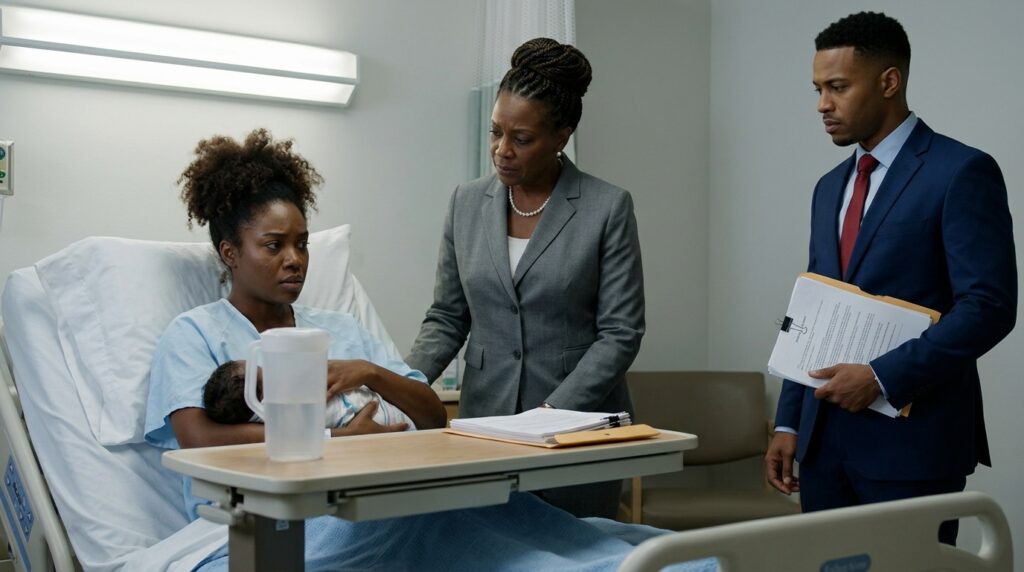
My husband divorced me beside our newborn because she wasn’t a boy. Months later, I walked into his wedding with our daughter and one sealed envelope.
The divorce papers hit my hospital blanket before my daughter was even forty-eight hours old.
Ryan stood at the foot of my bed in a pressed navy suit, staring at our newborn as if she were a defective product.
“I need a son, not a useless girl,” he said.
Then his mother, Margaret, folded her arms beside him.
“We need a grandson. Someone else has already done what you couldn’t.”
My hands tightened around Ava.
“Lauren is pregnant,” Ryan said. “And it’s a boy.”
Lauren Hayes. His marketing director. The woman he had called “just a coworker” every time her name lit up his phone after midnight.
I looked down at the papers. Ryan had already signed.
He wanted the house sold, our joint account divided, and one more thing that made my chest go cold.
He was disputing paternity.
“You’re saying Ava isn’t yours?”
Ryan shrugged. “It makes things cleaner.”
Cleaner.
He had spent my pregnancy rubbing my stomach and promising to teach our baby to ride a bike. Now, because she was a girl and another woman had promised him a son, he was trying to erase her.
I didn’t scream.
I called a nurse, had Ryan and Margaret removed, and phoned my attorney, Rachel Kim.
Rachel read the filing in silence.
“Emily,” she finally said, “do not answer the paternity claim yet.”
“Why?”
“Because Ryan may have just made the most expensive mistake of his life.”
Three weeks later, a certified envelope arrived from Bennett Trust & Estate.
Ryan’s late grandfather, Arthur Whitmore, had created a trust years earlier for Ryan’s first biological child.
Not first son.
First child.
That child received a major voting interest in Whitmore Development, the private construction company Ryan ran with Margaret.
Rachel ordered a legal DNA test.
Ryan fought it.
The judge ordered it anyway.
The result came back: 99.9999 percent probability that Ryan was Ava’s father.
Then Rachel found the clause no one expected us to read.
If Ryan knowingly denied his biological child to block that child’s trust rights, part of his own voting interest could be forfeited to the child’s trust.
Six months later, I walked into Ryan and Lauren’s wedding carrying Ava on one arm and one sealed envelope in the other.
Ryan saw me.
His smile disappeared.
I held up the envelope.
“Before you marry your replacement family,” I said, “you should probably read what your daughter owns now.”
Ryan stared at the envelope as if it might explode.
Margaret stepped between us.
“You have no right to interrupt this wedding.”
I handed the envelope to Ryan anyway.
He ripped it open.
The first page was the certified DNA report.
The second was a notice confirming Ava qualified as Arthur Whitmore’s first biological great-grandchild through Ryan’s line.
The third page drained the color from his face.
His written denial of paternity had triggered a formal review under the trust’s forfeiture clause. Rachel had already submitted the DNA result, hospital records, and divorce filing showing Ryan challenged paternity immediately after Ava’s birth.
The trust administrator’s preliminary decision was clear: the voting block Ryan expected to keep had been reassigned to Ava’s trust pending final confirmation.
“You wanted her erased,” I said. “Your grandfather planned for exactly that kind of man.”
Margaret grabbed the papers.
“Arthur intended this company to stay with the men in this family.”
A voice came from behind the guests.
“No,” said Charles Bennett, the trust attorney. “He intended it to stay with his descendants. He was very specific.”
Ryan’s jaw tightened.
Charles looked at him steadily. “The trust does not care what child you hoped for. It cares what child was born first, and you signed a sworn statement trying to deny that child.”
Several Whitmore executives in the front rows stopped whispering. One of them quietly took out his phone.
“Lauren is carrying my son,” Ryan snapped. “This changes nothing.”
Lauren, standing at the altar in an ivory gown, suddenly looked at the floor.
That was when the second secret surfaced.
Three days earlier, Lauren had contacted Rachel.
She had brought a prenatal paternity report from a Chicago clinic. Ryan had pressured her to take the test because Margaret wanted proof the unborn baby could eventually claim family assets.
Lauren had received the result two weeks before the wedding.
She told no one until Ryan demanded a prenup that morning giving her no claim to the company, the house, or the trust.
Ryan turned toward her.
“Tell them the baby is mine.”
Lauren’s eyes filled.
“Ryan…”
“Tell them.”
She shook her head.
A murmur rolled through the ballroom.
“The baby is a boy,” she said. “But Ryan is excluded as the biological father.”
Ryan looked completely lost.
“You planned this,” he said to me.
“No. You did.”
Popular Posts
→- 1
- 2
- 3
- 4




Recently Viewed
Stories you read recently will appear here.


