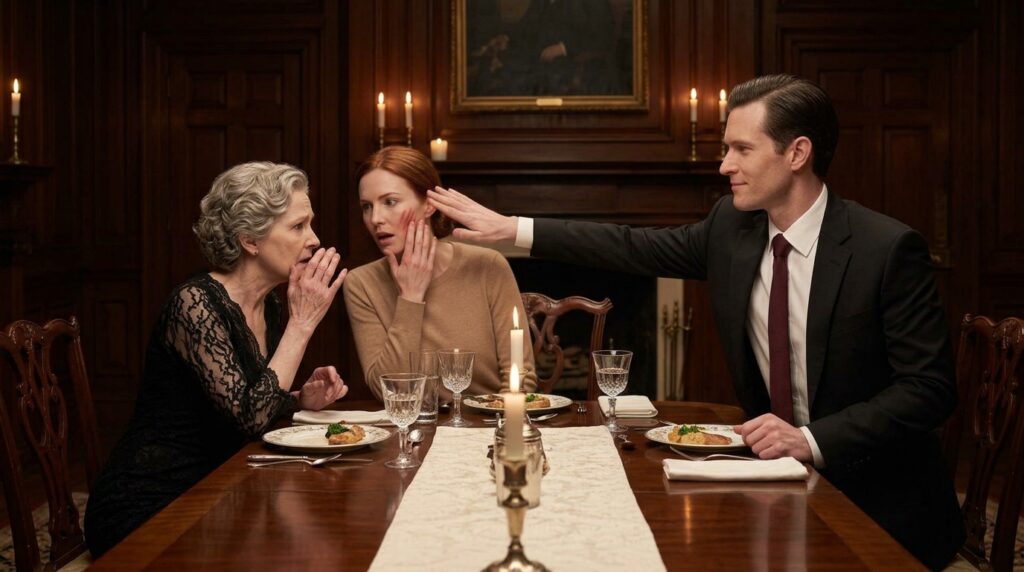
My Husband Struck Me at the Dinner Table in Front of His Entire Family. No One Moved. Then His 70-Year-Old Mother Leaned Toward Me, Her Hands Trembling, and Whispered, “I Stayed. Don’t Become Me.” I Excused Myself to Wash My Face, But Upstairs I Opened Something Richard Didn’t Know I Had.
No one moved.
No one spoke.
Then his mother leaned toward me and whispered three words that changed everything.
“Don’t become me.”
One second, I was laughing.
Genuinely laughing.
Daniel, Richard’s younger brother, had made some dry comment about a judge they both knew, and for once the humor was actually good enough to catch me off guard.
The next second, Richard’s hand moved.
There was a sudden contact against the side of my face.
My head turned.
One of my earrings swung against my neck.
Heat spread across my cheek.
And the dining room became so completely silent that I could hear the faint movement of the candles between us.
Every fork stopped.
Every glass remained suspended.
Richard’s father cleared his throat once.
That was all.
Not a question.
Not concern.
Just the small uncomfortable sound of a man waiting for an unpleasant moment to pass.
Daniel looked down.
Two cousins stared at their plates.
Richard remained standing beside his chair.
His suit was immaculate.
His wedding ring caught the candlelight.
“You embarrassed me,” he said.
I touched my cheek lightly.
No serious injury.
Just warmth and a growing visible mark.
Richard watched my fingers.
Something in his expression suggested that he had expected a different reaction.
Tears, perhaps.
An apology.
Maybe panic.
He got none of them.
Then Evelyn Bennett moved.
Richard’s mother was seventy years old.
She had spent most of dinner sitting at the far end of the table with the particular stillness of a woman who had made an art form out of becoming small without leaving the room.
She leaned toward me.
Her hands trembled.
Her eyes did not.
“I stayed,” she whispered.
Her voice barely carried across the table.
Then she said the words that changed everything.
“Don’t become me.”
Richard’s jaw tightened.
“Mother.”
One word.
Evelyn flinched.
It was small.
Almost invisible.
But I saw it.
Not a decision.
A reflex.
And in that reflex, I understood more about the Bennett family than I had understood in four years of marriage.
I stood.
“I’m going to wash my face.”
Richard settled back in his chair.
He mistook calm for surrender.
He often did.
I walked across the marble floor toward the powder room.
My heels made a steady sound.
Click.
Click.
Click.
To everyone else, I was a wife stepping away from an uncomfortable dinner.
To me, every step sounded like a countdown.
Because Richard Bennett had never completely understood who he married.
And the distance between the woman he believed I was and the woman I actually was had just become the most important fact in his life.
My name is Clara Reyes.
I kept my professional name after marriage.
Richard tolerated that decision the way he tolerated most things he could not completely control: with a tight smile and a memory long enough to bring it up later.
Before I married him, I spent eight years working in corporate compliance.
My specialty was financial misconduct.
Not the obvious kind.
I worked on the quiet cases.
Complex expense structures.
Hidden conflicts of interest.
Unusual payments routed through respectable organizations.
Private benefits disguised as corporate expenses.
Financial arrangements designed to look boring enough that nobody would ask a second question.
I was good at the work.
Very good.
I understood something many organizations learn too late.
The people most likely to misuse a system are often the people everyone has stopped examining.
Richard called my career “paperwork.”
He said it jokingly.
“You and your paperwork.”
“You really enjoy spreadsheets that much?”
“How many folders does one person need?”
I let him laugh.
I eventually discovered that being underestimated is sometimes an advantage.
I met Richard at a charity auction four years before that dinner.
He was a corporate litigator with a reputation for winning extremely difficult cases.
At the time, I found that impressive.
Later, I learned more about how he operated.
He was rarely openly improper.
He was too disciplined for that.
Instead, he applied pressure.
He knew which phone call would make someone nervous.
Which professional connection could make an opposing attorney reconsider how aggressively they wanted to proceed.
Which version of a story sounded most persuasive in a conference room.
Richard understood narrative.
That talent made him an excellent lawyer.
It also made marriage with him extraordinarily confusing.
At the charity auction, none of that was visible.
I saw a handsome man in a well-tailored suit who could hold a room’s attention without appearing to demand it.
He remembered my drink after hearing it once.
He remembered the name of my first supervisor.
He remembered that my father grew up in New Mexico.
He remembered the book I mentioned during our second dinner and brought me a first edition three weeks later.
Popular Posts
→- 1
- 2
- 3
- 4




Recently Viewed
Stories you read recently will appear here.


