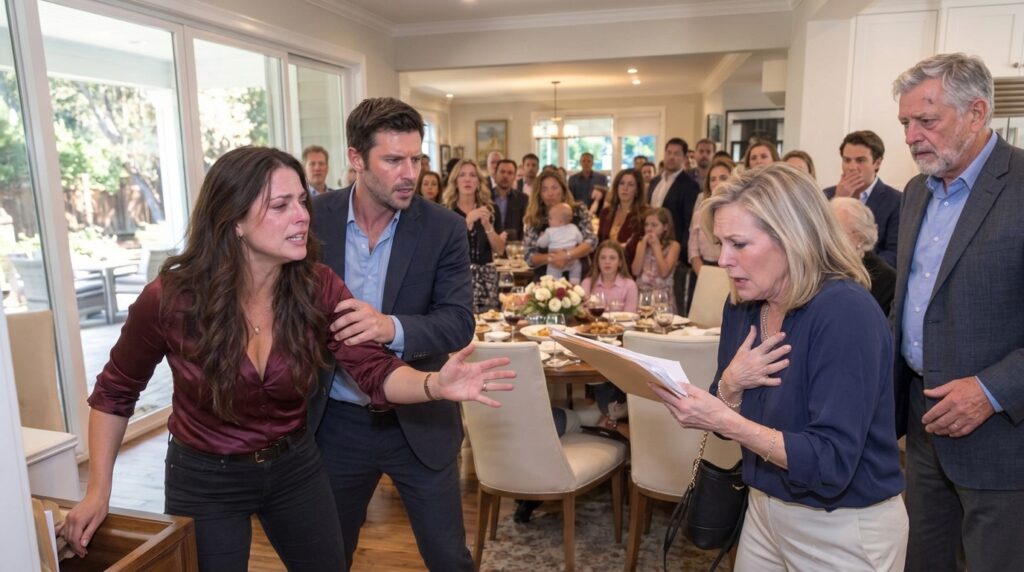
“Forty people are coming in ten minutes.”
I stared at my mother-in-law, Diane, as she stood in my kitchen like she had been planning this all week.
“Forty?”
She waved toward the front door. Cars were already pulling up.
“Friends from my church group. Some brought babies. You’ll watch the babies while we visit.”
I actually laughed.
“No. You invited them without asking me, and I’m not babysitting anyone.”
Diane’s smile vanished.
“This is my son’s house.”
My husband, Eric, had just walked in from the garage. He stopped cold.
“Mom, what are you talking about?”
She pointed at me.
“She refuses to help your family.”
I looked at Eric. “Did you know about this?”
He shook his head. “Not a clue.”
Another car door slammed outside. Then another. Within seconds, adults were carrying diaper bags toward our porch.
Diane lowered her voice.
“Don’t embarrass me. Take the babies upstairs.”
“No.”
“You live here because my son allows it.”
Eric’s face tightened. “Mom, stop.”
She turned on me.
“If you don’t like how things are done in my son’s house, pack a bag and leave.”
The room went silent.
I didn’t yell.
I didn’t cry.
I simply walked to the hallway, opened the small wooden drawer beside the entryway, and pulled out a thick envelope.
Diane followed me, confused.
I held it out.
“Check the drawer.”
She opened the envelope.
Her eyes moved across the first page.
Then the second.
The color drained from her face.
“What is this?” she whispered.
Eric stepped closer.
Diane suddenly grabbed the papers with both hands.
And when she realized exactly whose name was on every document, her hands started shaking so badly that the papers slipped from her fingers and scattered across the floor.
Teaser: She thought she could control the house because it belonged to her son. But one ordinary envelope was about to destroy a story she had been telling the family for years.
Diane didn’t move.
One page had fallen face-up on the hardwood.
Eric picked it up.
His eyes widened.
“Mom?”
Diane snatched it from him.
I stayed quiet.
The house had been a gift, at least that was what everyone had believed. But three years earlier, before Eric and I married, I had bought it myself with money from the sale of my late grandmother’s property. After the wedding, Eric moved in, and we treated it as our home.
Diane had never accepted that.
She had spent years calling it “Eric’s house,” telling relatives that her son was the one who had provided it.
What she didn’t know was what happened six months earlier.
I had refinanced the mortgage alone and updated my estate documents after an argument with Diane over my finances. The deed, closing statement, and county records were all in the envelope.
The house was legally mine.
But that still wasn’t why Diane was shaking.
Eric found another page.
“Why is there a list of forty names here?”
I took a breath.
“Because she didn’t just invite them.”
Diane looked at me.
I pulled out screenshots of the messages she had sent that morning.
She had told her church friends the house was available for a free “parents’ afternoon,” promised food, and said I would handle the babies while they relaxed.
Then I showed Eric the final message.
At the bottom was a sentence Diane had sent privately to one woman:
“Don’t worry about Jenna. She always gives in.”
Eric’s face hardened.
“You planned to dump forty people here and make my wife babysit?”
Diane started crying.
“I just wanted one afternoon.”
“No,” I said. “You wanted my house, my time, and my labor without asking.”
Then the real bombshell appeared.
Among the papers was a letter from our homeowner’s insurance company.
It stated that allowing a large group of children into the home for an organized childcare event could create serious liability issues if anyone was injured.
Eric stared at his mother.
“You put our house at risk?”
Diane shook her head. “I didn’t know.”
“You knew enough to invite forty people,” I said.
Outside, the front door opened.
One of Diane’s friends called, “Diane? Where should we put the diaper bags?”
Diane looked toward the doorway, then back at the papers.
For the first time, she seemed to understand that the party she had created could not simply be explained away.
She had told everyone this was her son’s house.
Now forty people were standing outside waiting to be welcomed into a home she had never owned.
And her biggest mistake was about to become public.
For several seconds, Diane just stared at the papers scattered across the floor.
Then she whispered, “You never told me.”
I looked at her.
“You never asked.”
Popular Posts
→- 1
- 2
- 3
- 4




Recently Viewed
Stories you read recently will appear here.


