PART 1
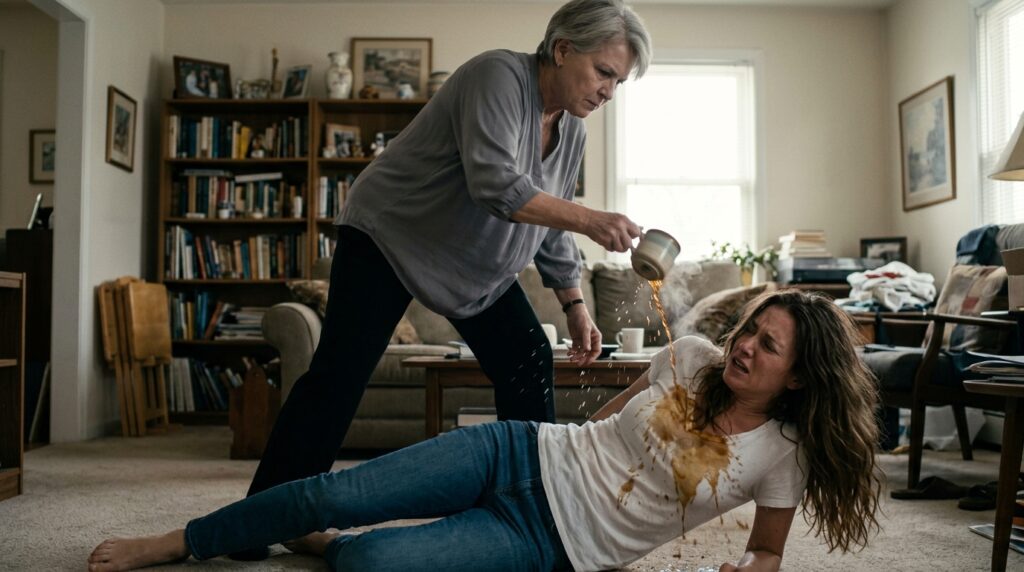
My mother-in-law poured boiling tea across my chest while I lay paralyzed on her living-room floor.
“Die quietly, trash,” Margaret whispered. “Once you’re gone, Daniel can collect the insurance money and marry someone respectable.”
She thought my husband and she had planned the perfect murder.
Then her phone vibrated.
The notification on the screen came from the one place she never expected—and the tiny red light blinking above her head had already captured everything.
Minutes earlier, I had been searching Margaret’s kitchen for my emergency allergy pen.
My throat was closing. My fingers were numb. Each breath came through a space that felt smaller than a drinking straw.
I knew the symptoms immediately.
Almonds.
Margaret knew about my allergy. Daniel knew too. They had watched me nearly die after a restaurant mixed almond flour into a dessert two years earlier.
That was why I never ate anything in Margaret’s house unless I saw the packaging myself.
But that afternoon, she had insisted the tea was plain.
“Just black tea,” she had said, smiling as she placed the porcelain cup in front of me. “Surely even you can manage that without causing a scene.”
I took one sip.
Within seconds, my tongue began to swell.
I shoved back my chair and reached for my bag, but it was gone.
Margaret stood beside the doorway holding it by one strap.
“Looking for this?”
I tried to speak, but only a thin rasp escaped.
She opened my bag, removed the allergy pen, and calmly placed it inside a locked cabinet.
Then she slid the key into her pocket.
That was the moment I understood.
This was not another cruel joke. It was not one of her humiliating family tests or a punishment for embarrassing her son.
She intended to watch me die.
I tapped the SOS button on my smartwatch just before my knees gave way.
My body struck the floor hard enough to rattle the tea service, but Margaret did not flinch. She stepped over me, adjusted the sleeves of her silk blouse, and carried the steaming pot into the living room.
My vision blurred around the edges.
I could not move my arms. I could not call for help. Every muscle seemed disconnected from my mind.
But I could still hear.
Margaret knelt beside me, her perfume filling what little air I had left.
“You should never have married into this family,” she said. “Daniel needs a wife with breeding, money, and a name people respect. You brought him nothing but debt and embarrassment.”
She lifted the teacup.
“The sooner you die, the better.”
Then she tipped it over my chest.
Scalding tea soaked through my blouse. Pain tore across my skin, but my swollen throat trapped the scream inside me.
Margaret watched my body convulse.
And smiled.
From the hallway, a floorboard creaked.
Daniel stepped into view.
My husband did not rush toward me. He did not shout for an ambulance. He looked down at his watch.
“How long?” he asked.
Margaret glanced at me as if I were an appliance slowly shutting off.
“Not long. Did you move her pen?”
“You have it.”
“And the cameras?”
“Security system is unplugged.”
Daniel walked closer and crouched near my feet. His face showed no panic, only irritation.
“You should have signed the new insurance forms when I asked,” he said. “You always made everything difficult.”
I stared at the man I had slept beside for six years.
Three months earlier, I had found an unfinished application on his laptop requesting an increase to my life insurance benefit.
The payout would have risen to two million dollars.
The beneficiary was Daniel.
He had forged part of my signature but had not yet submitted the final documents.
I canceled the entire policy the next morning.
I never told him.
Then, one month later, Margaret served me almond cake and claimed the bakery had mislabeled it. I survived because my pen was still in my pocket.
That was when I stopped believing in accidents.
I hired a private security technician under the pretense of upgrading our home network. He installed motion-activated cameras inside smoke detectors, bookshelves, and decorative vents.
Margaret knew about the old security system.
She had watched Daniel unplug it that morning.
She did not know the new cameras operated independently, backed up every recording, and transmitted emergency footage to a monitoring service whenever my watch sent a distress signal.
A tiny lens above the living-room shelves was recording her face.
It had recorded the tea.
It had recorded Daniel asking how long I had left.
And it had recorded every word about the insurance money.
Margaret patted my cheek with two fingers.
“Poor Evelyn,” she said. “Always trying to prove you belong somewhere you never did.”
Popular Posts
→- 1
- 2
- 3
- 4




Recently Viewed
Stories you read recently will appear here.


