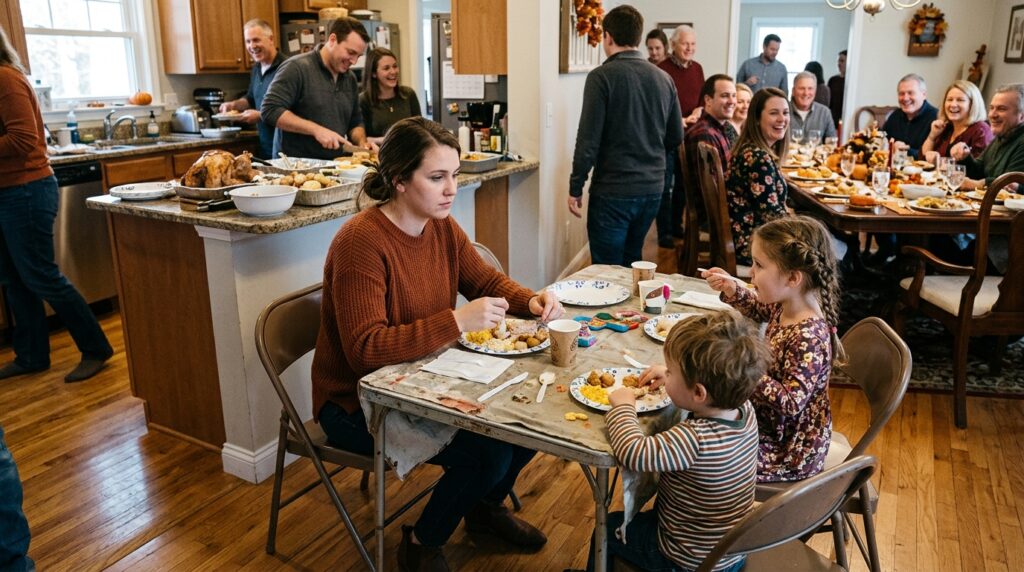
My Mother Made My Sons Sit at the “Poor Relatives” Table. By Monday…
Part 2: My father trusted me with the fortune nobody knew I controlled
My father, Arthur Dawson, died seven years before that Thanksgiving.
He was not wealthy in the flashy sense.
He wore work boots until the soles cracked.
He repaired agricultural equipment for farmers throughout southern Wisconsin.
He drove the same pickup for sixteen years.
But he understood land.
He understood patience.
And apparently, he understood our family far better than I did.
Three days before he died, he asked everyone except me to leave his hospital room.
His breathing was shallow.
His hands looked smaller than I remembered.
He squeezed my fingers.
“Claire,” he whispered, “I need you to take care of something.”
I leaned closer.
He told me he was leaving me forty-three acres surrounding our family cabin on Lake Winona.
The cabin itself was nothing extravagant.
Two bedrooms.
A stone fireplace.
A dock my father had rebuilt twice.
But the land had increased dramatically in value because developers had been buying nearby lakefront property for years.
I immediately assumed he meant for Mom to control it.
He corrected me.
“Not your mother. You.”
I remember staring at him.
“Why?”
His answer was simple.
“Because you understand the difference between owning something and protecting it.”
Then he told me about the trust.
For decades, he had quietly invested part of the profits from his repair business.
Nothing glamorous.
Index funds.
Municipal bonds.
A few conservative investments suggested by his accountant.
The money had grown into a substantial education fund for his grandchildren.
Every grandchild.
Lucas’s two boys.
Natalie’s daughter.
My two children.
And any future grandchildren who arrived within the terms established by the estate.
I would be trustee.
I protested immediately.
“Dad, Lucas understands business better than I do.”
My father almost smiled.
“Exactly.”
At the time, I did not understand what he meant.
After his funeral, attorney Rebecca Sloan walked me through the documents.
My responsibilities were strict.
The funds were not mine.
I could not use them personally.
I could approve legitimate education expenses.
I had to maintain records.
I had to protect the principal.
I had to treat every beneficiary fairly.
And I did.
For seven years.
Every January, I reviewed statements.
Every June, I met Rebecca.
Every distribution required documentation.
No exceptions.
My family knew Dad had left money “for the grandchildren.”
They did not know the amount.
They did not know the mechanics.
Most importantly, they never bothered to learn that I was the trustee.
My mother assumed a bank managed everything.
Lucas assumed an attorney did.
Natalie rarely asked.
I never corrected them because there was nothing to brag about.
The money did not belong to me.
The responsibility did.
Meanwhile, my ordinary life continued.
I cleaned teeth four days a week.
I packed lunches every morning.
I changed my own brake lights.
I bought clothes on sale.
My ex-husband, Brian, remained involved with the children, but his construction work kept him traveling.
I carried most of the daily responsibilities.
My mother interpreted my life as evidence that I had failed.
Lucas had become a regional operations director.
He owned a four-bedroom house with a heated garage.
Natalie married Derek Caldwell, whose family operated several upscale restaurants.
They traveled often.
They wore expensive clothes.
They recently hosted an elaborate tenth-anniversary vow renewal at a vineyard resort outside Milwaukee.
My mother adored talking about them.
When she spoke about me, she said things like, “Claire has always been simple.”
Simple.
Dependable.
Low-maintenance.
Those words sound harmless until you realize they mean nobody intends to invest much in you.
My father had been different.
Once, when I was nineteen, he secretly gave me eight hundred dollars before I returned to college.
“Don’t tell your mother,” he said.
I laughed.
“Why?”
His face became serious.
“She thinks you don’t need help because you never ask.”
That sentence followed me for years.
I thought not asking made me strong.
Eventually I realized it had simply made me convenient.
And convenience was about to become the most expensive mistake my family had ever made.
Because someone had assumed that the quiet daughter who never asked questions also never checked the paperwork.
They were wrong.
Part 3: A suspicious withdrawal revealed someone had forged my father’s authority
The first suspicious transaction appeared in July.
I nearly missed it.
The trust had several legitimate distributions that summer.
Lucas’s oldest son had started college.
There were tuition payments, housing expenses, textbooks, and fees.
Natalie’s daughter had attended an approved academic program.
Nothing unusual.
Then I noticed a withdrawal for $86,400.
The description was vague.
“Beneficiary advancement.”
That phrase bothered me immediately.
There was no beneficiary advancement provision.
I pulled the authorization.
My stomach tightened.
Popular Posts
→- 1
- 2
- 3
- 4




Recently Viewed
Stories you read recently will appear here.


