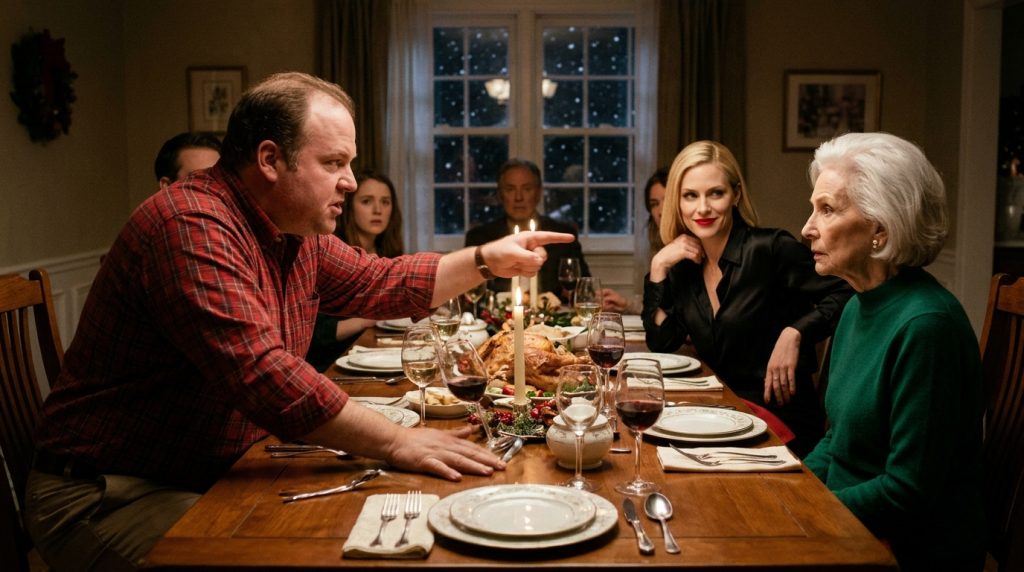
“Who is it?”
I looked up.
He waited.
I didn’t answer.
Julian smiled faintly and moved on.
What I noticed about him first wasn’t that he was talented.
Plenty of talented chefs had walked through kitchens where I worked.
It was the way he treated other people’s work.
At one point, my notebook was sitting near the pass.
Julian picked it up just enough to move it out of the way.
Then he put it back down without opening it.
That small gesture stayed with me.
He recognized that something could belong to me without needing to inspect it.
The night his consulting contract ended, I was breaking down my station alone.
Julian walked in, grabbed a towel, and started helping.
“You know you’re the best cook in this building,” he said.
I laughed because I assumed he was joking.
He looked at me.
“I’m including myself.”
I stopped wiping the counter.
People had praised individual dishes before.
No one with Julian’s experience had ever said something that direct to me.
Eventually, I told him why compliments made me uncomfortable.
I told him how often people had taken credit for my work.
He listened.
Then he said, “I’m not taking credit for it. I’m just refusing to pretend I didn’t taste it.”
That was Julian.
He never tried to rescue me.
He never told me I should forgive my family.
He never treated my past like a project he could fix.
He simply refused to participate in the old arrangement where I had to disappear so other people could feel important.
Once, later, he said something that stopped me harder than any professional compliment.
“You keep trying to be necessary.”
I looked at him.
“You don’t have to be necessary to be wanted.”
Rowan had once told me I didn’t have to earn him.
Then he had chosen the arrangement that made more sense to my family.
Julian never asked me to believe his words in advance.
He lived them.
We married three years later.
By then, my life had changed in another way too.
In 2020, I founded Ember and Ash Hospitality.
I didn’t build the company around revenge.
I built it around a problem I understood personally.
Too many kitchens were full of people whose skill disappeared behind someone else’s name.
Too many workers were treated as replaceable while the businesses above them depended on everything they knew.
So along with producing large-scale culinary events, we built a training program.
I had one rule for every new hire.
“Nobody in my kitchen stays invisible.”
It sounded personal because it was.
It also turned out to be good business.
People stayed.
They trained each other.
They knew their work would be recognized.
Our reputation traveled faster than I expected.
By 2025, Ember and Ash had grown to roughly sixty-five employees across several markets.
Sometimes I would stand at the edge of one of our events and watch a young cook explain a dish to a client.
Nobody sent them to the back because someone else looked better out front.
Every time that happened, something inside me settled a little more.
Then a national industry association selected our company to produce its annual gala in Nashville.
I was also being honored as the founder of Ember and Ash.
It was the kind of event my parents would have considered impossibly important when I was growing up.
Industry leaders.
Hundreds of guests.
A national program.
A room where every plate, table, timing cue, and service detail had to work.
We designed it down to the last table.
While reviewing the locked guest list, I saw a business name that made my hand stop over the screen.
The Soulberg Table.
Mil Haven, Ohio.
The association had sent its regular invitations to member businesses around the country.
No one had arranged for my family to be there.
No one had created a reunion.
Their name had simply landed on the list.
I could have removed it.
For a moment, I considered doing exactly that.
Then Julian came into the room.
I told him.
“You didn’t invite them,” he said.
“No.”
“And you’re not planning to walk over and welcome them personally.”
“Definitely not.”
He leaned against the table.
“You’re just not going to hide from them anymore.”
I looked back at the guest list.
“Those aren’t the same thing,” he said.
He was right.
So I left their names there.
There was another complication I didn’t fully appreciate at the time.
Julian was on the program too.
The invitation named the event and its honorees, but it did not tell attendees which production company was running the gala.
My family would not see my role clearly until they arrived.
I stepped completely away from the committee handling Julian’s recognition.
Popular Posts
→- 1
- 2
- 3
- 4




Recently Viewed
Stories you read recently will appear here.