Part 1: The Hook, a Standoff, a Skateboard and a Crowd of Phones
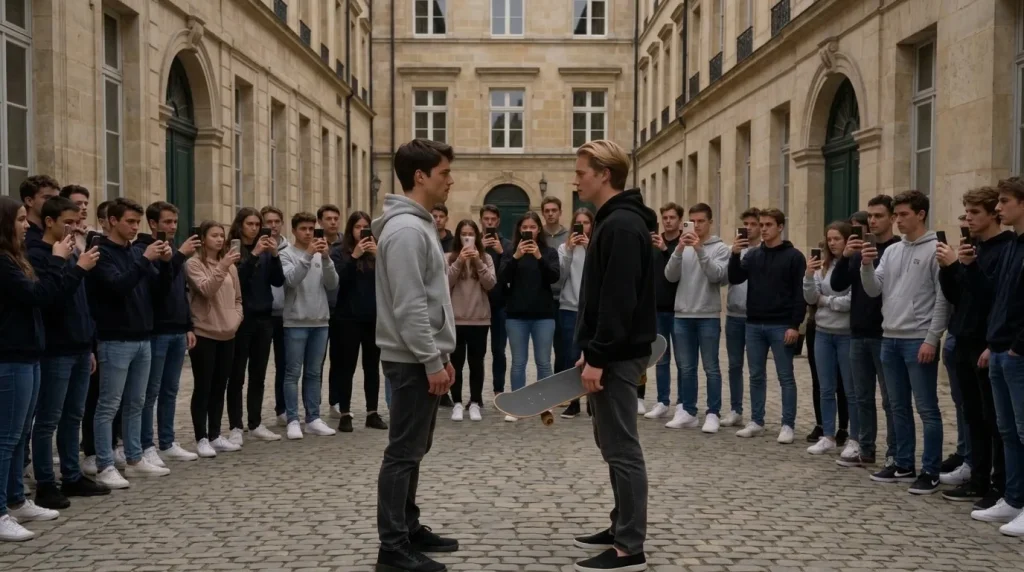
Few openings are as efficient as a standoff in front of a crowd. The clip begins in a wide, symmetrical shot of a cobblestone courtyard where two young men stand a few steps apart, surrounded by a semicircle of students who all hold up their phones. No one moves to stop what is coming. The viewer immediately understands three things: there is a conflict, there is an audience, and the audience is recording. That combination of tension and surveillance is deeply familiar to anyone who has scrolled through viral clips, which is why the opening feels instantly credible and instantly gripping.
In fifteen seconds the story passes through five distinct phases. First comes the standoff and the swing of a skateboard.
Second is the recoil, as the dark-haired man reels back. Third is a violent struggle that ends with the blond on his knees and the board broken on the stones. Fourth is the arrival of a black van carrying armed officers in tactical gear. Fifth is a final close-up in which the aggressor kneels with clasped hands while the man he attacked stands over him. Each phase reverses the emotional balance of the one before it, so the viewer is never allowed to settle into a fixed opinion.
The most striking idea in the clip is that the crowd is a character. Dozens of young people stand in a tight arc, faces half hidden behind their phones, and they never intervene. They are witnesses, judges, and content creators all at once.
Their presence raises the stakes, because every action in the courtyard is also a performance that will be seen by thousands. The aggressor is not only attacking a person, he is staging a spectacle, and spectacles have consequences. By giving the crowd so much screen time, the clip turns a simple fight into a comment on the way modern life is filmed, shared, and judged.
The ending is the most memorable part. Instead of a clean victory or a clean punishment, the clip stops on a tight image of fear and shock: the blond man kneeling in the foreground, his hands pressed together as if in prayer, while the man in the grey hoodie looms above him with a hand raised to his mouth. Whether the officers have come for one of them,
both, or neither is never explained. That unanswered question is the clip’s final hook. This blog breaks the story down in ten parts, from setting and costume to editing, AI craft, and the lessons every short-form creator can borrow.
Taken together, these choices create a clip that works on several levels at once. On the surface it is an action sequence with a fast, physical payoff. Underneath it is a morality tale about arrogance, retaliation, and the way public behavior meets public consequence. Viewers can enjoy it as a thrill, discuss it as an argument, or study it as a lesson in compact visual storytelling, and the best short videos always offer more than one way in.
Part 2: Setting and Cinematography
The location is a historic European-style courtyard paved in cobblestones,
framed by tall buildings of pale sandstone with symmetrical rows of windows. It is a space with weight and age, the kind of place that suggests universities, old institutions, and centuries of rules. Setting a violent confrontation here creates an immediate contrast between the dignity of the architecture and the messiness of human behavior. The sky is a flat overcast grey, which removes harsh shadows and gives the whole scene a calm, almost documentary quality. Nothing in the image is glamorous. It looks like a real afternoon in a real place, and that realism is what makes the escalation so unsettling.
The color palette is muted and cohesive: sand-colored stone, grey cobbles, black and grey clothing, faded denim, and a few soft pink and beige accents in the crowd. Because the environment is neutral, the two protagonists stand out by value rather than hue, one in a light grey hoodie and the other in a black hoodie. That simple contrast of light and dark is a classic way to separate characters visually, and it makes every body movement easy to follow, even during the blurred struggle. The overall tonal range stays soft and desaturated, which supports the serious mood and avoids the candy-bright look that often gives AI-generated videos away.
Popular Posts
→- 1
- 2
- 3
- 4




Recently Viewed
Stories you read recently will appear here.





