The salon owner placed the small item on the reunion table, and the backyard gathering that had been filled with excuses suddenly became the place where the truth started catching up with everyone. My sister had spent the afternoon saying my daughter’s haircut was an accident, but the scissors sitting in front of the family told a different story.
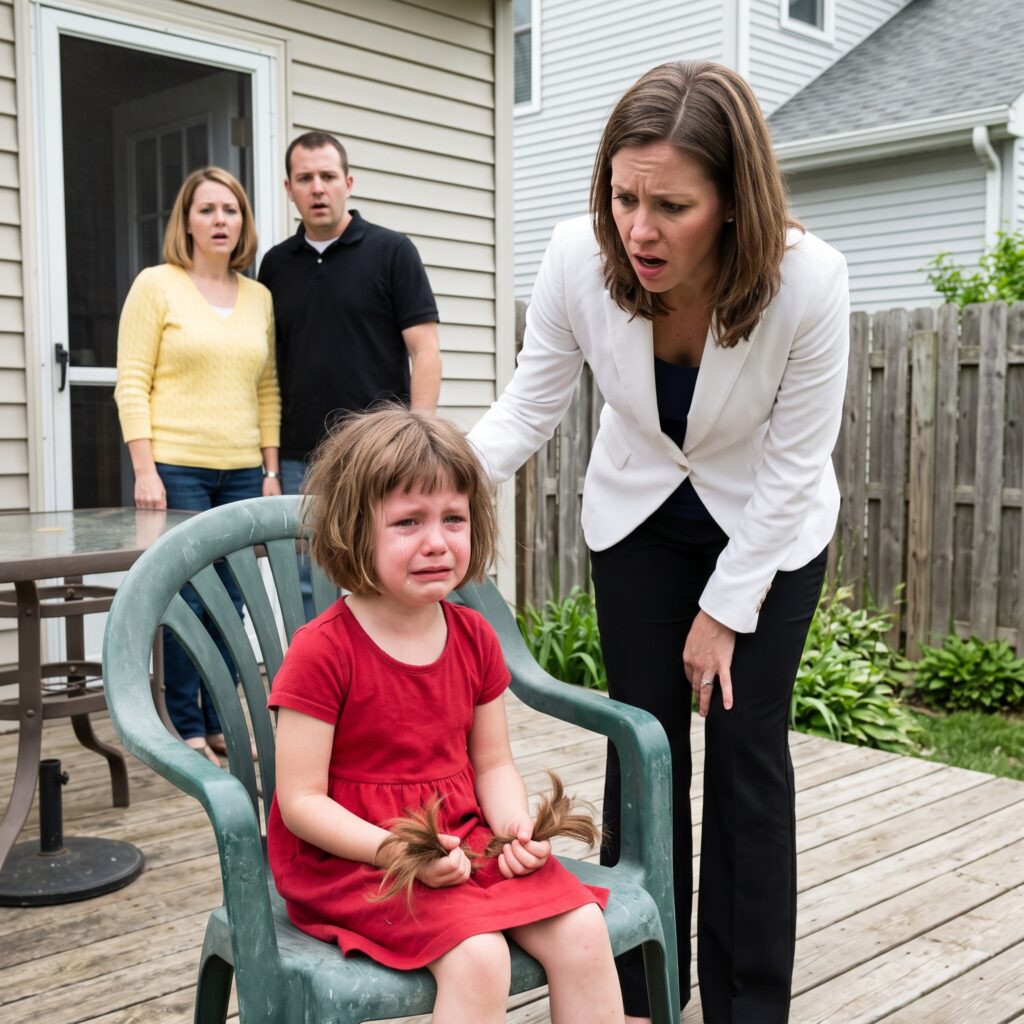
I had known something was wrong the moment I walked into my sister’s backyard. It was supposed to be a simple family reunion, the kind where everyone brings food, catches up, and pretends old disagreements can stay buried for one afternoon. But before I even heard an explanation, I saw my daughter sitting alone on a patio chair with her braid resting in her lap.
She was not holding a new hairstyle. She was holding something that had been taken from her.
For years, that braid had been part of her identity. She brushed it every night before bed. She was careful with it. She talked about keeping her hair long because it reminded her of promises I made when she was younger, promises about always protecting her and always being there when things were hard.
Now pieces of that braid were gone.
The cut was uneven. Strands hung around her shoulders in a way that made it obvious this was not a choice she had made for herself. Near her hairline was a small scratch, and every few minutes she lifted her hand toward that spot without realizing she was doing it.
The adults around the table kept repeating the same sentence.
It was an accident.
That was the explanation everyone seemed ready to accept before anyone even asked my daughter what happened.
My sister said her own daughter had always wanted longer hair. She said the scissors had been nearby. She said things got mixed up. She said she felt terrible.
But feeling embarrassed was not the same thing as being sorry.
I looked around that backyard waiting for someone else to say the obvious thing.
Someone should have asked my daughter if she was okay.
Someone should have admitted that cutting another person’s hair without permission was not a harmless mistake.
Someone should have cared more about the child sitting right there than protecting an adult’s comfort.
Nobody did.
Then my sister’s daughter walked over and showed me her new hairstyle.
At first, I thought she was just showing me what had happened afterward. But then I looked down at the pieces of braid on the ground.
That was when I noticed something that changed everything.
The cuts were not random.
They were careful.
The braid pieces had been removed in a way that showed planning. Someone had taken time to do it. Someone had made a decision before those scissors ever touched my daughter’s hair.
I asked where the scissors came from.
My sister immediately reached for them. She said they were old salon scissors she kept at home. She tried to move the conversation away from the details and back toward the idea that everyone should just forgive and move on.
But before she could put them away, the salon owner who had been invited to the reunion stepped closer.
She had been sitting quietly while everyone argued about what they thought happened. She had not interrupted. She had not made assumptions. She had simply watched.
Then she saw the scissors.
Her expression changed.
She looked at the tool in my sister’s hand. Then she looked at my daughter’s damaged braid.
She recognized something that nobody else in the backyard understood.
Those were not ordinary scissors someone randomly grabbed from a drawer.
They were a pair she knew.
The salon owner explained that she had ordered them herself and marked them for a specific reason. They were not the kind of scissors that would normally be sitting around a home for a child to pick up during a family gathering.
The details mattered.
The explanation my sister had given depended on everyone ignoring those details.
But once people started paying attention, the story became harder to defend.
The same family members who had quickly called it an accident started looking at each other differently. They remembered the timing. They remembered who had been near the scissors. They remembered how quickly everyone tried to explain away my daughter’s pain before understanding it.
My daughter stayed beside me, still holding what was left of her braid.
That image was the part I could not forget.
She was not asking for revenge. She was not trying to embarrass anyone. She was a child who wanted the adults around her to admit something simple: what happened to her mattered.
A forced apology would not fix that.
A quick excuse would not fix that.
What mattered was honesty.
My sister tried to interrupt as the salon owner continued explaining why she recognized the scissors. She wanted to control the conversation again. She wanted to bring everyone back to the version where nobody was responsible and everyone could leave the reunion without conflict.
But the room had changed.
Popular Posts
→- 1
- 2
- 3
- 4




Recently Viewed
Stories you read recently will appear here.


