PART 1: THE SIX FEET THAT CHANGED EVERYTHING
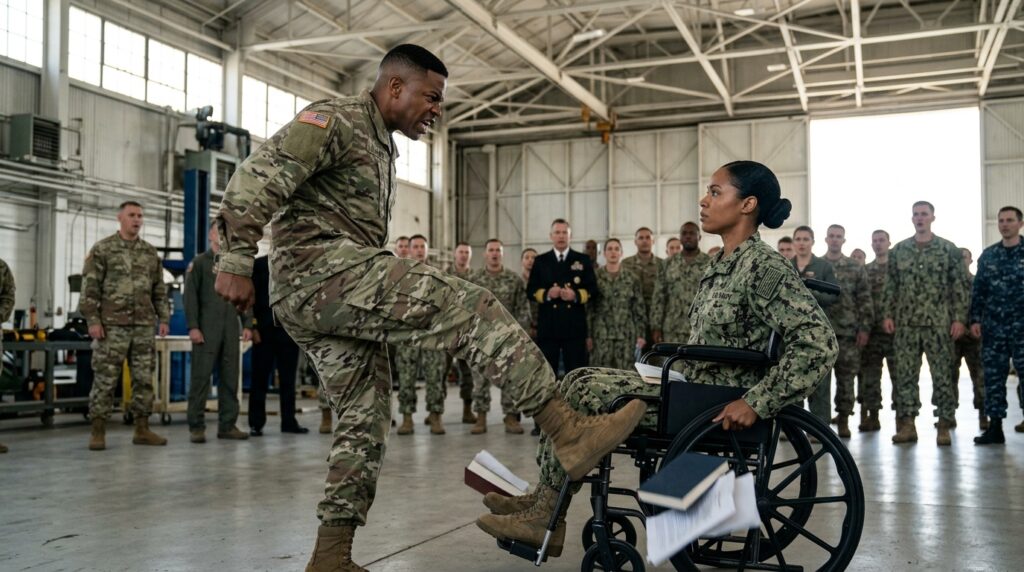
Sergeant Derek Vance kicked my wheelchair so hard it slid six feet across the concrete floor of a military training hangar.
Then, in front of forty-three soldiers, he leaned toward me and shouted, “Get up, cripple!”
For three seconds, nobody moved.
My black notebook lay open on the floor. My pen had rolled beneath a steel equipment rack. A sharp pain was spreading through my left hip, and the right side of my wheelchair was making a faint mechanical clicking sound that hadn’t been there before.
But the pain wasn’t what frightened me.
What frightened me was the silence.
Forty-three soldiers stood inside Joint Tactical Training Bay Three, and almost every one of them was looking at Derek Vance, waiting to see how he wanted them to react.
Not one person had laughed at his insult.
Not one person had challenged him.
They were waiting for permission to decide whether what they had just witnessed was wrong.
I looked up at Derek.
“Are you finished, Sergeant?”
His expression changed.
He had expected me to cry. Maybe scream. Maybe beg him to back away.
Instead, I was looking at him the same way I had looked at damaged equipment, incomplete safety reports, and officers who confused impressive presentations with actual readiness.
I was assessing a problem.
And Derek Vance had just made himself the biggest problem in the room.
What he didn’t know was that I hadn’t come to Fort Bradford as a helpless visitor.
I had been sent there to evaluate men exactly like him.
Twenty minutes earlier, I had entered the hangar through its eastern service doors.
My motorized wheelchair hummed quietly beneath me as I crossed the yellow safety markings near the entrance. The building smelled of hydraulic fluid, warm rubber, machine oil, and the bitter coffee that seemed to exist in every military facility I’d ever entered.
Soldiers moved between training stations. Metal equipment rattled against storage racks. Instructors shouted timing commands over the noise of simulated tactical exercises.
I wore my uniform, but no escort walked beside me. No officer announced my arrival.
That was intentional.
My assignment required observing how personnel behaved when they weren’t performing for someone they recognized as an authority.
I had learned long ago that a perfectly rehearsed inspection could tell you very little about the people being inspected.
A five-minute interaction in a hallway sometimes told you everything.
I was thirty-two years old, a chief petty officer assigned to a joint readiness evaluation team, and I had spent thirteen years in uniform.
Most of those years had taught me to pay attention to small things.
Who spoke freely.
Who lowered their eyes.
Who corrected a mistake without being ordered.
Who looked toward a superior before answering a simple question.
The last of those habits had always interested me most.
When soldiers become afraid to tell the truth, their units become dangerous long before anybody notices a failure on a performance chart.
I rolled farther into the bay.
A corporal standing near an equipment station noticed me first.
He nudged the soldier beside him.
“Looks like command finally sent us an observer in a wheelchair.”
The second soldier laughed.
“Guess standards are getting lower.”
I heard both of them.
I kept moving.
I had spent too many years listening to strangers make assumptions about my body to waste energy correcting every one.
My chair had become part of my daily life after a service-related injury left me with permanent mobility limitations.
The rehabilitation had been difficult.
Learning how to navigate a military career afterward had been harder in ways I hadn’t expected.
People who had never seen my records decided what I could understand.
People who had never worked beside me questioned what I could contribute.
Some spoke slowly, as though losing the ability to walk had somehow damaged my hearing.
Others called me inspiring for accomplishing things they would have considered ordinary if I had been standing.
I had stopped trying to win those people over with speeches.
Competence was usually the better answer.
Across the hangar, Sergeant Derek Vance stood beside a group of soldiers preparing for a tactical movement drill.
He was broad-shouldered, with a thick neck and the stiff posture of someone who enjoyed being watched.
His voice carried across the room even when he wasn’t giving instructions.
Beside him stood Corporal Ryan Cole and Specialist Mason Price.
I noticed their expressions before I noticed anything else.
Ryan looked tired.
Mason looked alert in a different way, constantly checking Derek’s face before smiling or responding.
Then Derek saw me.
He gave my wheelchair a long, theatrical inspection.
“Look at that,” he announced. “Command finally made inspections wheelchair-accessible.”
Several soldiers laughed.
Ryan smiled briefly, then looked away.
Mason laughed louder than anyone.
I made a mental note.
Popular Posts
→- 1
- 2
- 3
- 4




Recently Viewed
Stories you read recently will appear here.


