Part 2: The Cruiser
The bus had barely rolled a foot when a black-and-white police cruiser swung out of the traffic and stopped nose-first across its path. Its tires squealed against the asphalt, and the blue and red lights began to pulse across the storefront windows.
Greg slammed the brake. The whole bus lurched, and a few passengers grabbed the handrails.
“What the hell?” he muttered, gripping the wheel.
Officer Marcus Davis stepped out of the cruiser. He was a tall man in his forties with a steady, unhurried walk, and he did not look angry. That was what made it unsettling. He looked like a man who had already decided exactly how this would go.
He walked to the driver’s window and tapped on the glass twice.
Greg hit the button and the window slid down. “Officer, is there a problem? I’m on a tight schedule here.”
“Turn off the engine, sir.”
“I really don’t think I—”
“Turn off the engine.”
Something in Davis’s voice carried more weight than the words. Greg turned the key, and the diesel rumble died. The silence that followed felt enormous.
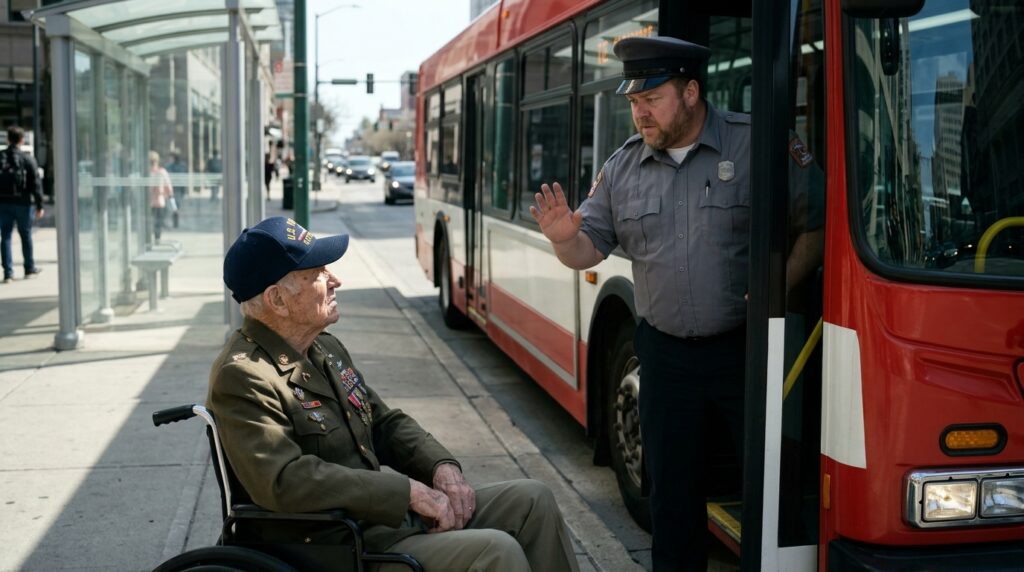
On the curb, Arthur sat very still in his wheelchair, his medals catching the afternoon light. A Purple Heart. A Bronze Star. A faded ribbon from a campaign most people on that street had only read about. His hands, spotted with age, rested on his knees. He had been rejected so quietly and so casually that he was still absorbing it.
Davis glanced at him, then back at Greg.
“I was parked across the street,” he said. “I watched the whole thing. You looked at that man, you looked at the ramp, and you waved him off like he was a stray dog.”
Greg’s face flushed. “The ramp was jammed. It’s a mechanical issue.”
“Is it?”
“I don’t have time to—”
“Sir,” Davis said, still mild, “I’m going to ask you to step off the bus.”
The passengers had all gone quiet. A teenager near the back lifted his phone. A woman in scrubs shifted in her seat, and her expression made it clear she had wanted to say something for the last two minutes and was relieved someone finally had.
Greg hesitated. For the first time since Arthur had rolled up to the door, his confidence faltered.
“You can’t just—”
“I can,” Davis said. “And I’d rather do this the easy way.”
The bus door hissed open.
Part 3: The Ramp
Greg climbed down the steps slowly, as if the pavement might give way beneath him. A small crowd had gathered on the sidewalk: shoppers, a food vendor, two men in construction vests. Nobody was shouting. Everyone was watching.
Davis walked past Greg without another word and stepped onto the bus. He crouched beside the door, studied the ramp mechanism, and pressed a button on the panel.
The ramp unfolded smoothly, without a single hitch, and settled onto the curb with a soft metallic clunk.
Davis stood and turned around. “Funny. Works perfectly.”
Greg opened his mouth. Nothing came out.
“Let me save us both some time,” Davis said, stepping back onto the sidewalk. “You didn’t check the ramp. You didn’t ask if he needed help. You saw a man in a wheelchair, decided it would cost you three minutes, and drove on.”
“I’m already behind schedule,” Greg said weakly. “Management is on my case every day—”
“Management didn’t tell you to leave a veteran on the curb.”
Arthur cleared his throat. His voice was thin but steady. “Officer, please. It’s all right. I can wait for the next bus.”
Davis turned to him, and his whole face softened. “Sir, with respect, it is not all right. And you are not waiting for anything.”
He crossed the sidewalk and crouched so that he was level with Arthur’s eyes. “Can I ask where you served?”
“Korea,” Arthur said. “The Chosin Reservoir. Winter of fifty. I was nineteen.”
A murmur went through the crowd. Some of them knew exactly what that name meant. The others understood from the way Davis lowered his head.
“My grandfather was Marine Corps,” Davis said quietly. “He never talked about it either. Not once. After he passed, we found a shoebox full of ribbons in the attic.”
Arthur smiled, a small, tired, grateful smile. “That sounds about right.”
Behind them, the woman in scrubs had stepped off the bus. “I called dispatch the moment he drove past,” she said. “I told them what I saw. I’m so sorry I didn’t do more.”
“You did plenty,” Davis told her.
Greg stood at the edge of it all, alone and strangely small. He looked at Arthur’s medals and then at his own hands, and something flickered across his face. It might have been shame. It might have been the first honest look at himself in years.
Popular Posts
→- 1
- 2
- 3
- 4




Recently Viewed
Stories you read recently will appear here.


