PART 1: THE HAND ON MY SHOULDER
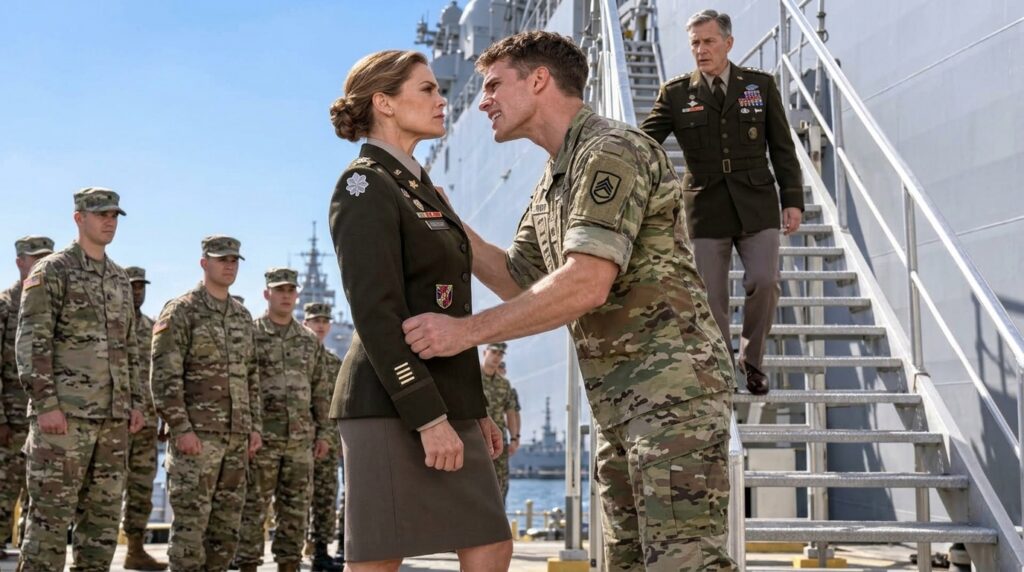
My brother still had his hand wrapped around my uniform when the one-star admiral stopped halfway down the gangway.
For most people, that would have been the moment they realized they had made a catastrophic mistake.
Brandon just smiled.
The pier at Naval Base San Diego smelled of saltwater, diesel exhaust, wet steel, and coffee that had probably been sitting in a pot since before sunrise. The gray hull of the USS Sterett rose above us, enormous enough to turn conversations into echoes. Chains rattled somewhere forward. A forklift beeped in reverse near a stack of supplies. Sailors moved across the pier with the practiced speed of people who knew every minute of their morning belonged to someone else.
And in the middle of all that disciplined motion, my younger brother was squeezing the sleeve of my dress uniform like we were children fighting in our parents’ kitchen again.
“The guys are laughing, Sis,” he said.
His voice carried.
He wanted it to.
Around us, several sailors had stopped pretending they were not watching.
“They think this is some kind of Halloween joke.”
A few nervous chuckles followed.
Brandon looked pleased with himself.
That was the thing about my brother.
He had never needed a crowd to be cruel, but a crowd always made him more ambitious.
I looked down at his hand.
His fingers were pressed directly over the sleeve beneath my gold braid.
“Take your hand off me, Petty Officer.”
For half a second, something changed in his face.
Not recognition.
Annoyance.
Then he laughed.
“Or what?”
Another chuckle from somewhere behind him.
“You’re going to report me to the PTA?”
He pushed my shoulder backward.
Not hard enough to knock me over.
Hard enough to make sure everyone saw.
My heels struck the concrete with a sharp click.
I heard somebody inhale.
Brandon leaned slightly closer.
“Go back to your office, Sandra.”
His voice dropped just enough to pretend the next words were private.
They were not.
“Before you create trouble for both of us.”
I could smell the coffee on his breath.
Thirty years of family history stood between us.
Thirty years of my father telling people that Brandon was the one who had inherited the Owens military blood.
Thirty years of being expected to smile.
My father, retired Army Sergeant Major Richard Owens, had spent twenty-six years wearing the uniform. Our childhood home had been a museum dedicated to duty. His shadow box hung in the den. His retirement saber sat beneath it. Photographs from Germany, Korea, Fort Hood, and Fort Bragg covered an entire wall.
Dad had rules for everything.
Shoes lined up.
Beds made properly.
Show respect to the uniform.
Stand when a senior officer enters the room.
Know the chain of command.
Apparently, none of those rules applied when the officer was his daughter.
When Brandon enlisted directly out of high school, Dad threw a barbecue large enough to feed half the neighborhood.
“My boy is carrying on the family tradition,” he told everyone.
Brandon had been nineteen.
I had already been serving for several years.
Nobody mentioned that.
When I graduated with honors from my commissioning program, Dad shook my hand and said, “Nice.”
When I received my first command, he asked if the position came with an office.
When I made captain, he congratulated me over voicemail because Brandon had come home that weekend and Dad wanted to take him fishing.
And when I sent my parents the official photograph after I was promoted to rear admiral, two silver stars resting on each shoulder board, Dad studied the picture for several seconds and said, “I guess they hand out titles differently these days.”
A retired Sergeant Major knew exactly what two stars meant.
That was what hurt.
Not ignorance.
Choice.
Dad had chosen not to see me.
Over the years, I learned what every overlooked child eventually learns.
You can spend your entire life trying to become impressive enough for somebody who has already decided not to be impressed.
Or you can stop performing for them.
I stopped.
Mostly.
I still went home for Thanksgiving.
I still called Mom every Sunday.
I still remembered Dad’s birthday.
I still sent Brandon Christmas gifts, even after he began introducing me to friends as “my sister who does Navy paperwork.”
Every insult had a smile attached.
That was Brandon’s preferred method.
If I objected, I was sensitive.
If I corrected him, I was arrogant.
If I mentioned my rank, Dad would sigh and say, “Family doesn’t need all that military nonsense.”
Interesting, considering military nonsense was the central organizing principle of our entire childhood whenever Brandon was involved.
So I learned to stop defending myself.
Let people believe what they wanted.
Rank does not require applause to exist.
Popular Posts
→- 1
- 2
- 3
- 4




Recently Viewed
Stories you read recently will appear here.


