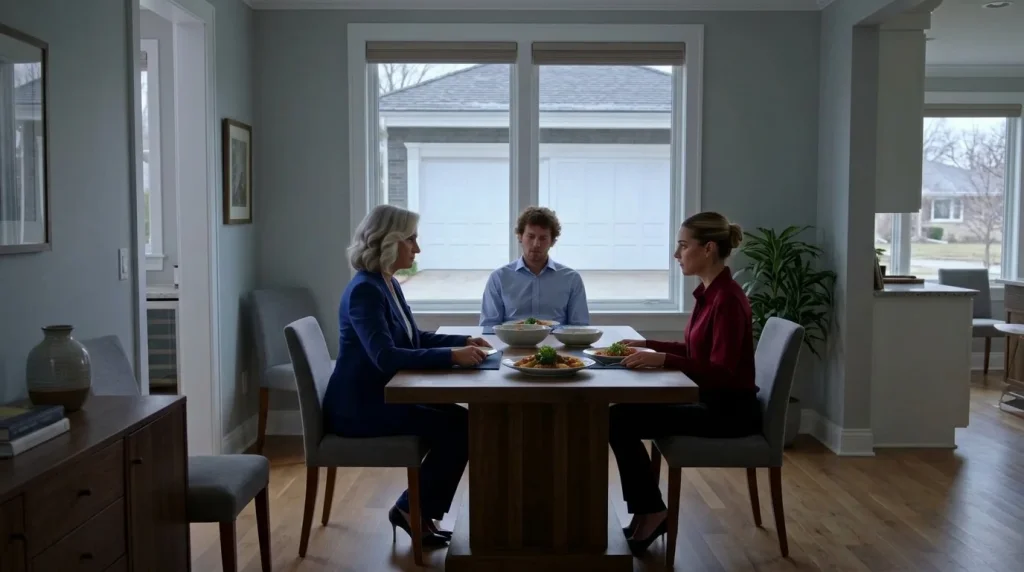
Her tone wasn’t warm or welcoming.
It sounded like she was laying out the terms of an employment contract.
Then she said the sentence that changed everything.
“We’re not going to support some useless freeloader.”
I slowly turned toward my son.
I expected him to stop her.
To correct her.
To explain the truth he had known for years.
He knew who actually owned the house.
He knew whose name appeared on the deed.
He knew who paid the property taxes, insurance, and other expenses connected to ownership.
But instead of defending me, my son simply nodded.
And in that single moment, I learned everything I needed to know.
Years earlier, before he married her, my son had come to me during one of the hardest periods of his life.
Money was tight.
His future felt uncertain.
More than anything, he wanted stability and a home where he could eventually build a family.
I wanted to help him.
So I purchased a three-story house in my own name and allowed him to live there while he got back on his feet.
He handled the ordinary household expenses.
I remained responsible for the costs of actually owning the property—the taxes, insurance, and other obligations required to protect it.
There had never been any confusion between us.
My son knew perfectly well that the house belonged to me.
His wife apparently didn’t.
At some point, the story had quietly changed.
A house his parent had provided became, in their version of events, a house they owned.
I never bothered correcting that assumption because I never imagined there would come a day when I needed to prove anything.
But that evening, I had arrived carrying an envelope.
Inside was something neither of them knew about.
My retirement plan had never been to move into their home and expect them to support me.
I wanted to spend several months living together to see whether the arrangement worked for everyone.
If we could share the house peacefully and treat one another with respect, I intended to sign the property over to my son.
Completely.
No rent.
No complicated conditions.
No grand announcement.
I simply wanted the home to become theirs because I believed they had built a family there with the opportunity I had given them.
Instead, I was sitting at their dinner table being told I would need to pay $2,000 every month for the privilege of living in a house that legally belonged to me.
When my daughter-in-law insisted that her demands were perfectly reasonable, I finally asked one question.
“Whose house do you think this is?”
The atmosphere changed instantly.
My son stopped playing with his napkin.
His wife stared at me, confused.
For the first time that evening, both of them realized we were no longer discussing my retirement arrangements.
We were discussing ownership.
I opened the envelope.
Then I placed three documents on the table.
The first was the property record.
My name was clearly listed as the owner.
Also addressed to me.
The third was an old occupancy agreement.
At the bottom was my son’s signature.
My daughter-in-law slowly read through each document.
Then she turned toward her husband.
“What is this?”
He didn’t answer.
So I turned the property record toward her.
“This house belongs to me.”
Her expression changed completely.
She looked at my son.
“You told me this was our house.”
He swallowed.
“I said it was going to be ours.”
And suddenly, I understood that the problem was much bigger than one insulting dinner.
My son hadn’t merely allowed his wife to misunderstand who owned the property.
He had built their future around something that was never legally his.
And when she called me a freeloader, he remained silent because correcting her would have meant admitting how much of their comfortable life had been possible because of me.
His wife pushed her chair away from the table.
“You knew she owned it?”
My son looked at me instead of answering her.
That was when I reached into the envelope again.
There was one final document.
But this paper wasn’t evidence of what already belonged to me.
It showed what I had been prepared to give away.
I placed the unsigned property-transfer document on the table.
“I was planning to give you this house,” I said. “That was the retirement conversation I thought we were going to have tonight.”
My son stared at the document.
His wife did too.
Her voice became quieter.
“You were really going to give us the house?”
“Yes.”
She looked at the unsigned page again.
“Were?”
I folded my hands on the table.
“Yes.”
One word.
Nothing more was necessary.
A gift that valuable requires trust.
Sharing a home requires mutual respect.
Popular Posts
→- 1
- 2
- 3
- 4




Recently Viewed
Stories you read recently will appear here.





