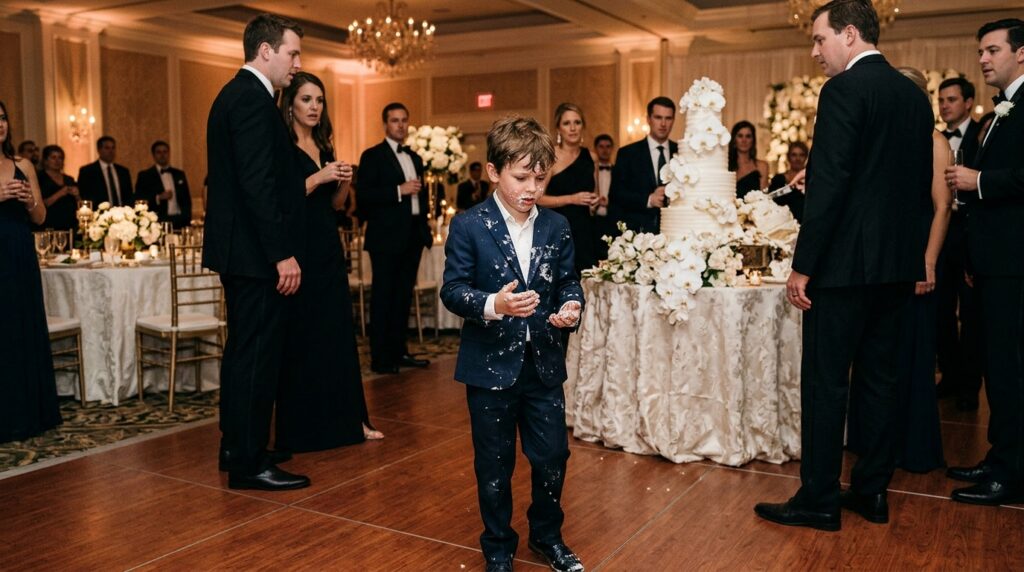
The sound my son’s head made when it hit the marble pillar was not the sound of an accident.
It was the sound of a family secret breaking open.
One second, my eight-year-old boy was on the ballroom floor, shaking, covered in white frosting from a ruined wedding cake he had never meant to touch. The next second, my mother had her manicured hands on him, screaming that he had destroyed everything, as if his fragile little body mattered less than sugar, orchids, and the opinion of rich strangers.
My name is Melissa Sterling Carter.
For thirty-three years, I believed being born into the Sterling family meant I owed them loyalty.
I believed silence was maturity.
I believed forgiveness was strength.
I believed family could hurt you and still be family.
I believed my mother’s coldness was just old Boston pride.
I believed my father’s cruelty was discipline.
I believed my brother’s selfishness was something he would eventually outgrow.
I believed if I stayed quiet enough, useful enough, obedient enough, someday they would look at me and see a daughter instead of a tool.
Then my mother put her hands on my sick child.
And the woman they had trained to be silent finally died.
I was born in Boston, Massachusetts, in one of those old red-brick neighborhoods where every building looked like it had secrets in the walls. My father, Richard Sterling, liked to say our family had “history.” He said it the way other men said “wealth,” “honor,” or “power.”
“The Sterling name is a shield,” he used to tell me. “Everyone in this family bleeds a little to keep it polished.”
But as I got older, I realized I was the only one bleeding.
My younger brother, Brandon, was the family prince.
He was charming in the way spoiled men often are. Handsome enough to be forgiven, lazy enough to need rescue, arrogant enough to believe rescue was his birthright.
If Brandon got a C, my parents praised his “social intelligence.”
If I got an A-minus, my father asked why it was not an A.
If Brandon crashed a leased car, my mother blamed the dealership.
If I worked sixty hours a week and still showed up to Sunday dinner, my parents asked why I looked tired.
I studied healthcare administration at Boston College. I worked nights, weekends, holidays. I built a career without my father’s connections. I learned how hospitals ran, how departments survived budget cuts, how patient advocates fought insurance companies, and how families broke down under fluorescent lights while doctors spoke in careful voices.
Maybe that was why I understood fear before most people my age did.
Real fear.
Not embarrassment.
Not inconvenience.
Not bad press.
Fear.
The kind that sits in your throat while a doctor explains that your baby’s brain is under pressure.
My son, Patrick, was born eight years before Brandon’s wedding.
He came into this world small, swollen, and fighting.
Doctors diagnosed him with hydrocephalus when he was still an infant. Too much cerebrospinal fluid was building up inside his brain, widening the ventricles and creating dangerous pressure. When he was three weeks old, neurosurgeons implanted a shunt to drain the fluid into his abdomen.
I remember the first time I saw him after surgery.
His tiny body looked almost lost under the hospital blankets. Tubes. Monitors. Bandages. The soft beep of machines keeping time with my terror.
My husband, David, stood beside me and held my hand so tightly I thought our bones might fuse.
David Carter was not from old money. He was a high school history teacher from Worcester, the kind of man who carried extra granola bars in his backpack because one of his students might come to class hungry.
He did not wear designer suits.
He did not name-drop.
He did not care who had a summer house on Nantucket.
He was steady.
That was the word I always came back to.
Steady.
When Patrick cried through therapy, David sang old baseball songs off-key.
When I was too exhausted to speak, David made grilled cheese and cut it into triangles because Patrick thought triangles tasted better.
When my parents skipped birthdays, school events, and hospital visits, David never said, “I told you so.”
He just held our little family together with both hands.
Patrick’s condition affected everything.
His head was larger than other children’s. His balance was poor. His legs trembled when he got tired. His hands shook when he tried to hold a fork or button his shirt. Bright lights overwhelmed him. Loud rooms frightened him. Crowds made him dizzy.
But Patrick was not his diagnosis.
He loved dinosaurs.
He laughed at terrible knock-knock jokes.
He called David “Professor Dad” when David graded papers at the kitchen table.
He believed every dog was a potential best friend.
Popular Posts
→- 1
- 2
- 3
- 4




Recently Viewed
Stories you read recently will appear here.


