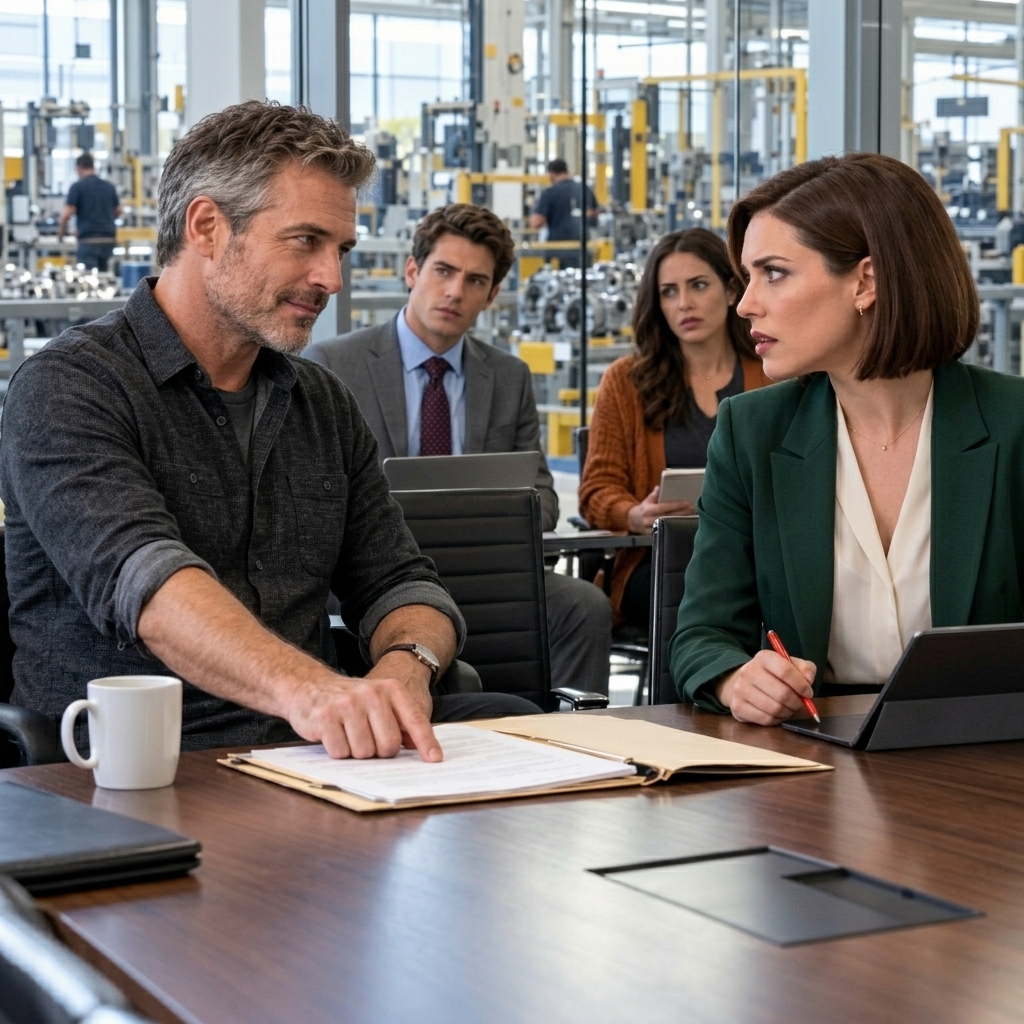
They fired me effective immediately. The words came across the polished conference table, delivered with the casual authority of someone who had never spent a day on a factory floor. Olivia Matthews, the newly appointed CEO of Sterling Automotive Parts, didn’t even look up from her tablet when she said it. Mid-thirties, sharp blazer, McKinsey consultant written all over her posture. She was scrolling through spreadsheets, a red stylus in hand, circling line items like they were personal enemies.
I’m Harold Peterson, forty-nine years old, and I’ve spent the last twenty-eight years building manufacturing systems that actually work. Not the kind that look good in PowerPoint presentations, but the kind that keep 2,400 people employed and $180 million in orders flowing through twelve facilities across four states. I sat there, hands flat on the table, watching her perform what she clearly thought was decisive leadership.
“The transition will be immediate,” she continued, still not making eye contact. “We’re bringing systems management in-house. More efficient. Better cost control.”
Behind her sat two people I had never seen before: a nervous woman from HR clutching her tablet and a younger guy in an expensive suit who had consultant written all over him. No one from operations. No one who had ever walked a production floor. Just Olivia and her imported expertise. She finally looked up, her expression somewhere between bored and irritated, like I was wasting her valuable time by still breathing.
“Before you go,” she said, tapping her stylus against the tablet, “hand over the smart factory system. All of it. Access credentials, source code, documentation. We need everything by end of business today.”
The room went quiet. The HR woman shifted in her seat. The consultant stopped typing on his laptop. I didn’t move, just sat there, keeping my face neutral and letting the silence stretch. Olivia’s eyebrow rose slightly.
“Is there a problem?”
I smiled, the kind of smile you give someone when you know something they don’t. “I’m afraid I can’t do that.”
Her stylus stopped mid-tap. “Excuse me?”
“The system,” I continued, my voice steady and professional. “It’s not yours to take.”
Olivia’s confident posture shifted, just slightly. A flicker of confusion crossed her face before the corporate mask returned. “We paid for development. That makes it company property.”
I shook my head slowly. “You paid for operational access, not ownership. The distinction is outlined clearly in Section Seven of your service agreement.”
The consultant leaned forward, whispering something to Olivia. She waved him off, her eyes locked on mine. “This is absurd. You can’t hold company infrastructure hostage.”
“I’m not holding anything hostage,” I replied. “I’m simply clarifying what you legally control, which, as of this moment, is absolutely nothing.”
What Olivia Matthews didn’t know—what her consultant, her HR team, and her entire cost-optimization plan had completely missed—was that the smart factory control system running Sterling’s entire operation wasn’t software sitting on their servers. It was custom-built infrastructure I owned personally, licensed for their use and controlled from hardware they had never seen. When they terminated my contract three minutes earlier, they had disconnected themselves from the only thing keeping their manufacturing network from collapsing. In forty-eight hours, that oversight would cost them everything.
But I’m getting ahead of myself. Let me back up and show you exactly how a manufacturing systems engineer with twenty-eight years of Ford Motor experience got fired by someone who thought factory automation was just an app on a dashboard.
I started at Ford right out of college, back when American manufacturing meant something. Spent eight years on the floor before moving into systems integration. I learned early that manufacturing isn’t about dashboards and data visualization. It’s about understanding how physical machinery interacts with control systems in real time, under real pressure. When Ford started their efficiency improvements in 2018, I saw the writing on the wall. I watched eight hundred good people lose their jobs because some consultant convinced management they could run the same production with half the workforce.
That was when I went independent. I built my first custom ERP integration in 2019 for a Tier Two supplier in Ohio. Word spread quietly through industry circles, the kind of reputation that gets you calls when someone’s operation is falling apart and conventional solutions have failed. I don’t have a fancy LinkedIn profile. I don’t post about Industry 4.0 synergies or digital transformation journeys. My clients find me when their systems are broken and their MBA consultants have no clue how to fix them.
That was how I ended up working with Sterling Automotive Parts five years ago. George Whitman, their VP of operations at the time, called me on a Thursday afternoon. His voice had the tight edge of someone staring at disaster.
“Hal, we just failed our third quality audit in six months,” he said. “OEM contracts are threatening cancellation. I need someone who understands how this actually works, not another consultant who learned manufacturing from case studies.”
Popular Posts
→- 1
- 2
- 3
- 4




Recently Viewed
Stories you read recently will appear here.


