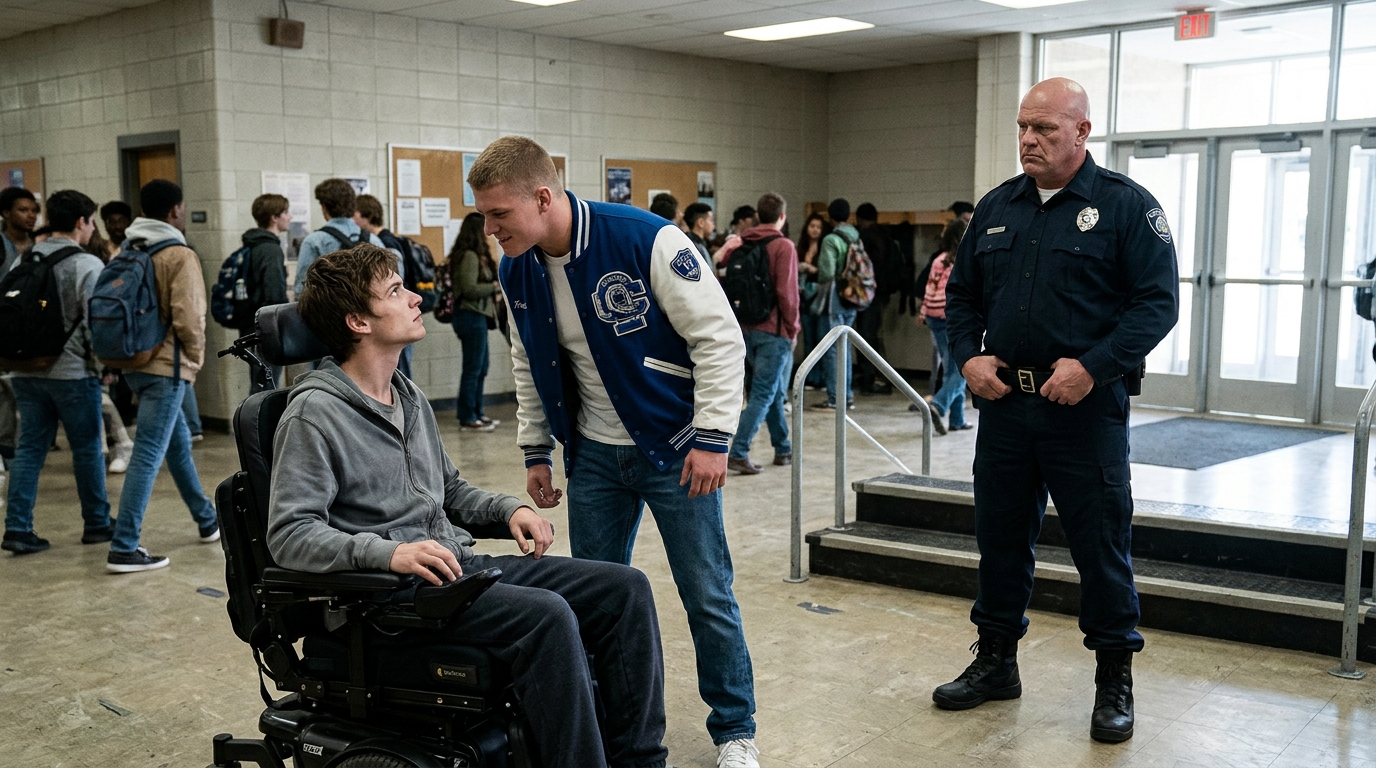
Travis Hale came running up behind Dylan Mercer’s wheelchair, his teammates watching, and slammed both hands into the back of it.
“Take the stairs, Mercer!”
The wheelchair lurched forward.
Its front wheels caught the edge of the two steps leading down from the upper landing of the crowded school lobby. The heavy chair twisted sideways, then overturned, throwing 17-year-old Dylan against the concrete steps.
“My shoulder!”
His cry barely carried over the laughter.
It was noon at Westbridge High School in upstate New York. Students were gathering around the lobby, and Travis, the school’s celebrated starting quarterback, had spotted two girls near the elevator.
Apparently, humiliating someone who couldn’t walk was his idea of impressing them.
Dylan lay awkwardly against the steps, his left shoulder burning and his wrist trapped beneath him.
His overturned wheelchair continued making a faint mechanical clicking sound.
Travis grinned at his teammates.
But one girl, Ellie Foster, wasn’t laughing. She pushed through the crowd, trying to reach Dylan without moving him before someone checked whether he was injured.
Then Martin Voss, the school’s head of security, came down the adjoining hallway.
He looked at Travis.
Then at Dylan.
“You blocked the landing.”
Dylan stared at him.
“He pushed me.”
Voss didn’t even ask the quarterback what had happened.
For months, Travis had been treating the school’s accessible elevator as his personal shortcut. Whenever Dylan reached it first, Travis would shove his wheelchair out of the way, sometimes hard enough to send him rolling toward the opposite wall.
And whenever Dylan complained, Voss had the same answer.
Stop holding everyone up.
The elevator itself had also developed a strange habit of becoming unavailable during lunch, forcing Dylan to take a longer route around the building.
Dylan had been born with a severe condition affecting the strength and function of his legs. He used a powered wheelchair, but he had never allowed it to define everything he could do.
He loved programming.
He could spend hours writing software, designing accessible navigation tools, and finding ways to make ordinary technology work for people whose needs were usually ignored.
He wanted to become an accessibility systems engineer.
But at school, even getting to class had become a fight.
That afternoon, his mother took him to urgent care. The doctor documented his injuries, including a badly bruised shoulder and a sprained wrist.
When the school suggested resolving the incident privately,
Dylan refused.
He wanted the assault officially investigated.
He wanted the missing elevator access explained.
And he wanted someone to stop Travis before another student ended up on those steps.
The response was a warning.
Travis’s father, Gregory Hale, sat on the district’s Board of Education. He had powerful connections to the school’s athletic program, and Dylan’s complaints were now being described as an attempt to destroy a promising young athlete’s future.
But Gregory didn’t know something important.
Two years earlier, Dylan had built a shock-resistant recording system into his wheelchair.
It was originally designed to document dangerous jolts, collisions, and accessibility problems.
Its cameras and motion sensors automatically preserved footage when the chair experienced a violent impact.
And at noon that day, the recorder had captured what happened from behind.
There was no accidental collision.
No misunderstanding.
The video showed Travis running straight toward the chair and deliberately shoving it toward the steps.
Dylan handed a protected copy to his mother.
Then he began looking into the other incidents.
While reviewing the school’s poorly secured surveillance archive, a system he had encountered during an earlier accessibility technology project, he discovered camera recordings that had never been included in the school’s incident reports.
The footage showed Travis repeatedly pushing his wheelchair away from the elevator.
It showed security staff ignoring his complaints.
And it showed something else.
On a day when the accessible elevator had supposedly been broken, someone had deliberately switched it out of service.
Dylan enlarged the recording.
The man standing beside the elevator was wearing a dark security uniform.
It was Martin Voss.
The same man who had blamed Dylan for falling down the stairs.
And Dylan was beginning to realize that the bullying might not be the only thing his school had been covering up.
Part 2: The Elevator That Was Never Broken
Dylan didn’t sleep that night.
His left arm hung in a navy sling, and every time he shifted in bed, his shoulder reminded him of the concrete steps. But pain wasn’t what kept him awake. It was the image frozen on his laptop screen: Martin Voss standing beside the accessible elevator, a key card in his hand and a small, satisfied smile on his face.
Dylan had watched the clip a dozen times.
Voss didn’t look like a man fixing a broken machine. He looked like a man closing a door.
Popular Posts
→- 1
- 2
- 3
- 4




Recently Viewed
Stories you read recently will appear here.


