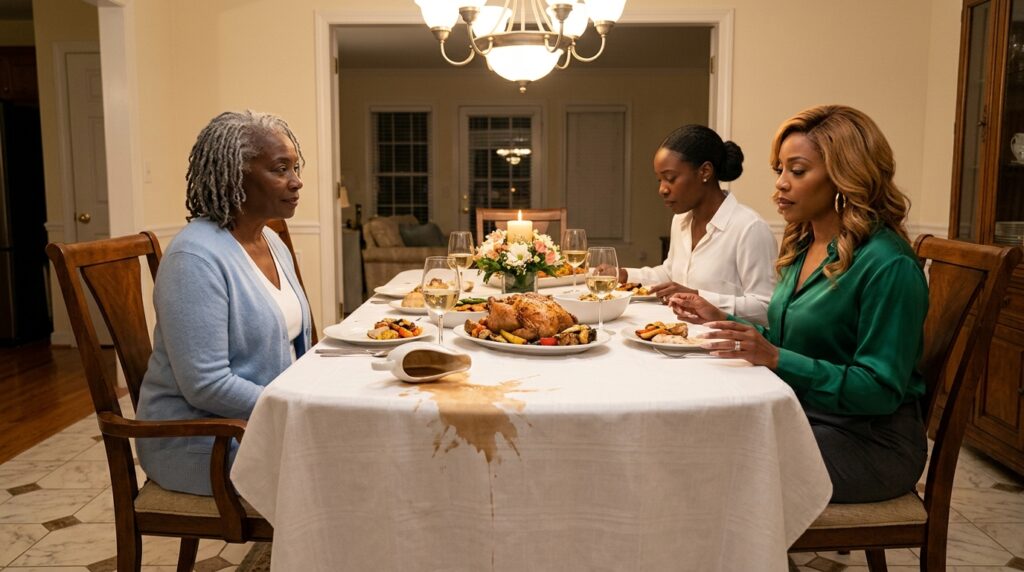
When My Sister Shoved Me Off My Chair at Dinner, She Didn’t Know I Had Already Paid $228,000 for Her Free Life
When My Sister Shoved Me Off My Chair at Dinner, She Didn’t Know I Had Already Paid $228,000 for Her Free Life
Part 1: The Laugh at the Table
My sister shoved me off my chair in the middle of Sunday dinner, and the whole table laughed.
Not a shocked laugh.
Not an uncomfortable little sound people make when they do not know what to say.
They laughed like I had finally landed where they thought I belonged.
On the tile.
Below them.
Out of the way.
My name is Dana Fletcher, and the house where it happened was the same house I had paid for every month for five years.
It was a white two-story house on Briar Lane in a quiet coastal town outside Savannah, Georgia. It had blue shutters, a sagging porch swing, and a dining room floor my father had laid with his own hands back when I was twelve. He had measured every tile twice, kneeling there in faded jeans, a pencil tucked behind his ear, humming old Motown songs while my mother told him he was too slow.
“Good work takes time, Lorraine,” he used to say.
That floor had survived Thanksgiving spills, birthday cake crumbs, my high school graduation party, my sister Carla’s first baby shower that never became a baby, and the night we brought my father home from the hospital after his first minor heart scare.
Then, years later, I hit that floor hard enough to bruise my hip and knock the breath out of my chest.
Carla stood over me with one hand still on the back of my chair.
She was forty-one then, five years older than me, though she acted younger when it helped her and older when it gave her authority. She had dyed honey-blonde hair, perfect acrylic nails, and a way of smiling that made every insult seem like a joke until you bled from it.
Our mother, Lorraine, sat at the head of the table in her soft blue cardigan, her fork frozen halfway to her mouth.
Aunt Ruth, my father’s older sister, stared down at her plate.
Two of Carla’s friends, Melissa and Taryn, sat beside the china cabinet with glasses of white wine, laughing into their palms.
And Carla, sitting in my father’s chair, tilted her head and said, “Oh, Dana, don’t be dramatic. You barely fell.”
Barely fell.
Like I had lowered myself gracefully onto the tile for attention.
Like she had not grabbed the chair and shoved it backward because I had asked, calmly, whether she could help with the roof repair bill.
My palm stung. My left knee throbbed. The whole room smelled like roast chicken, buttered corn, and the cheap floral candle my mother lit every Sunday even when no one deserved warmth.
I looked up at Carla from the floor my father had laid.
For one strange second, I did not feel pain.
I felt clarity.
Sharp.
Bright.
Cold.
I smiled.
“Enjoy this dinner,” I said. “It’s your last free one.”
The room went quiet.
Carla’s laugh died first.
Then Melissa’s.
Then Taryn looked at her wineglass like something dangerous had crawled into it.
My mother whispered, “Dana.”
Not “Are you hurt?”
Not “Carla, what have you done?”
Just my name, in that old warning tone she used whenever I got too close to the truth.
I stood slowly. My blouse had twisted at the shoulder. There was gravy on my sleeve from where I had knocked the tablecloth. My knee wanted to buckle, but I did not give them the satisfaction.
Carla crossed her arms.
“What’s that supposed to mean?”
“It means exactly what it sounds like.”
“You’re threatening us at dinner now?”
“No,” I said, brushing off my pants. “I’m done funding it.”
My mother’s face hardened. “This is your family.”
I looked around the room.
At the woman who had birthed me and then slowly taught me that my usefulness mattered more than my dignity.
At my sister, who had turned grief into a throne.
At Aunt Ruth, who knew better but had chosen silence because silence was easier than confrontation.
At two women I barely knew, who had just watched me get shoved to the floor and laughed because Carla had trained the room to treat me like background furniture.
“This,” I said, “is not family.”
Then I picked up my purse from the sideboard and walked out of the dining room.
Behind me, Carla called, “Where are you going?”
I paused at the front door.
The house smelled like my childhood. Lemon cleaner. Old wood. My father’s memory. My mother’s denial.
For five years, that smell had cost me $3,800 a month.
For five years, I had paid to be unwanted in the house I was saving.
Popular Posts
→- 1
- 2
- 3
- 4




Recently Viewed
Stories you read recently will appear here.


