He was beginning to carry them himself.
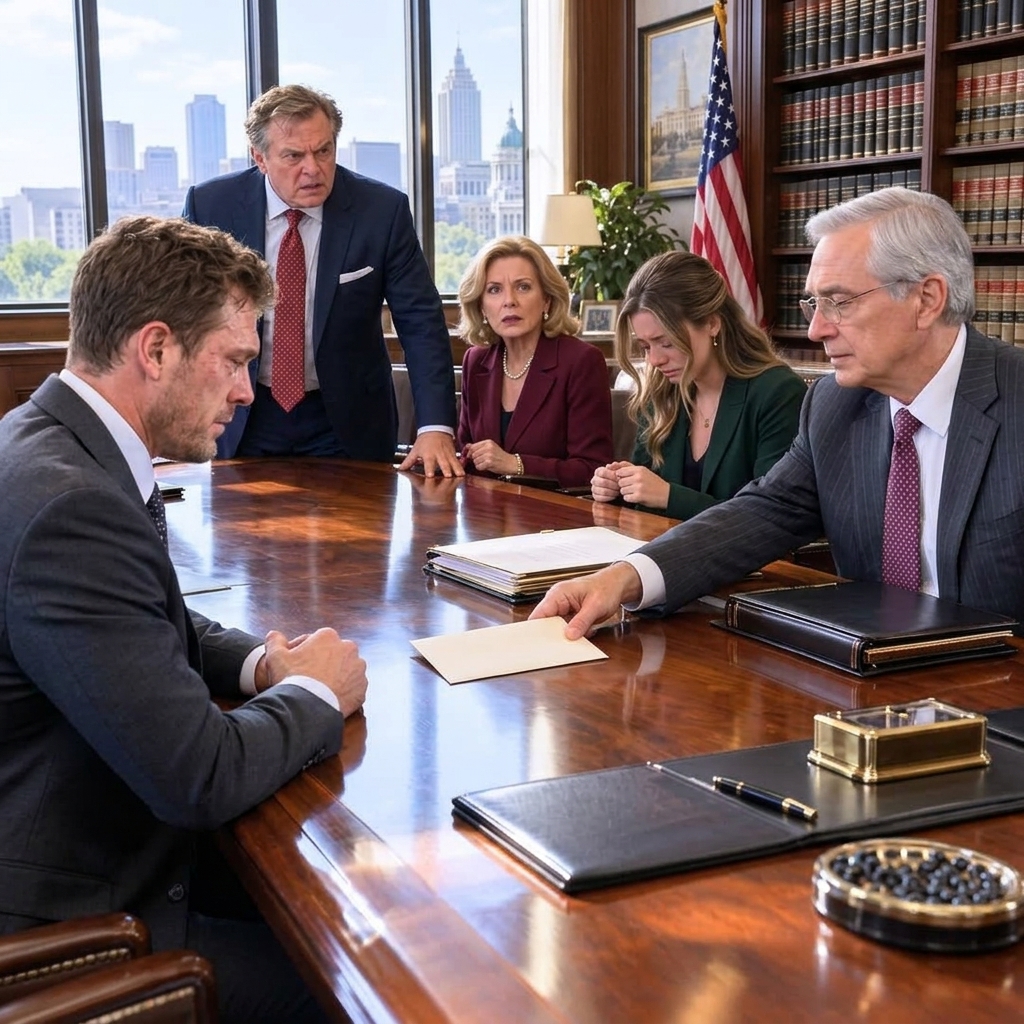
The hearing resumed thirty minutes later.
The board’s attorney explained that the support referral would be reviewed confidentially as part of the district’s examination of its handling of student welfare concerns.
Additional records would be preserved.
The earlier incident reports would be reconsidered.
Coach Brennan would be questioned about his knowledge of the complaints and the guidance given to Marcus.
The principal’s handling of the disciplinary process would also be reviewed.
Then the board chair addressed Eli.
“Elijah, would you like to make a statement?”
He hadn’t prepared one.
Rebecca had offered to speak for him.
His parents had told him he didn’t owe the room anything.
But when the board chair asked, he found himself standing.
He walked toward the microphone.
His hands were cold.
The room seemed larger than it had from his seat.
He glanced at Naomi, Maria Delgado, Mr.
Harrison, and his parents.
Then he looked toward Marcus.
“I didn’t want any of this,” he began.
His voice sounded thin through the microphone.
He cleared his throat.
“I went to lunch because I was hungry.”
A few people smiled sadly.
“I sat at a table because it was empty.”
He paused.
“I didn’t think that would become an argument.”
He looked down at his hands.
“When Marcus came over, I thought if I stayed quiet, he’d get bored and leave.”
Eli raised his eyes.
“He didn’t.”
His voice strengthened.
“He knocked my milk over.
He hit me.
He shoved me.”
He glanced toward the board.
“Then he rushed at me, and I moved because I didn’t want him to hit me again.”
The room was still.
“I didn’t know what would happen when he tripped.”
Eli swallowed.
“I didn’t want him to get injured.
I just wanted him to stop.”
He thought about the days following the confrontation.
The suspension.
The edited video.
The strangers arguing about him.
The teacher who had grabbed his collar.
Then he spoke the words that had been forming inside him all week.
“The worst part wasn’t being hit.
It was realizing how quickly everyone was willing to decide what happened without asking me.”
Grace lowered her head.
Thomas stared at his son.
Eli continued.
“I know I wasn’t perfect.
Maybe I should’ve walked away before anything happened.”
He hesitated.
“But I also think people should be able to sit down and eat lunch without having to earn the right to be left alone.”
He looked toward Marcus.
“I heard your apology.”
Marcus met his gaze.
“I don’t know what to do with it yet.”
Marcus nodded.
Eli turned back toward the board.
“But I hope what happened changes something.”
He took a breath.
“Not just for me.”
He looked toward the students seated at the back.
“For the next kid who gets told to move.”
Then he stepped away from the microphone.
The board did not announce every decision that evening.
Some questions required further investigation, and some personnel matters had to be handled through district procedures.
But the core finding concerning Eli came quickly.
After reviewing Naomi’s video, independent witness accounts, and the available evidence, the board determined that the original conclusion had been unsupported.
Eli’s administrative suspension was rescinded.
The disciplinary record connected to the cafeteria incident would be corrected.
The school would provide written acknowledgment that the available evidence showed Marcus initiated the physical confrontation and Eli had responded defensively.
The announcement brought Grace to tears.
Thomas wrapped an arm around her.
Eli remained sitting.
He had imagined feeling triumphant.
Instead, he felt exhausted.
Like someone who had been holding his breath underwater for far too long and had finally reached the surface.
Across the room, Marcus listened as the board chair explained that his conduct would be addressed separately.
The district would also review why his earlier request for behavioral support had not resulted in sustained intervention.
Marcus was removed from football activities pending disciplinary review.
His university recruitment process would be affected, though its final outcome remained outside the school’s control.
He accepted the consequences without arguing.
Charles Bell left before the meeting ended.
His son didn’t follow.
Over the following weeks, the cafeteria incident became something larger than anyone had anticipated.
The district appointed an independent reviewer to examine earlier complaints and the handling of student discipline.
Several reports previously marked resolved were reopened.
Families were invited to submit information about incidents they believed had been inadequately addressed.
The review uncovered inconsistent documentation, delayed responses, and instances where informal conversations had replaced formal follow-up.
It did not mean every accusation was automatically accepted.
Each case required its own evidence.
But the district could no longer claim the pattern had gone unnoticed.
Principal Whitmore was placed on administrative leave during the review.
Popular Posts
→- 1
- 2
- 3
- 4




Recently Viewed
Stories you read recently will appear here.