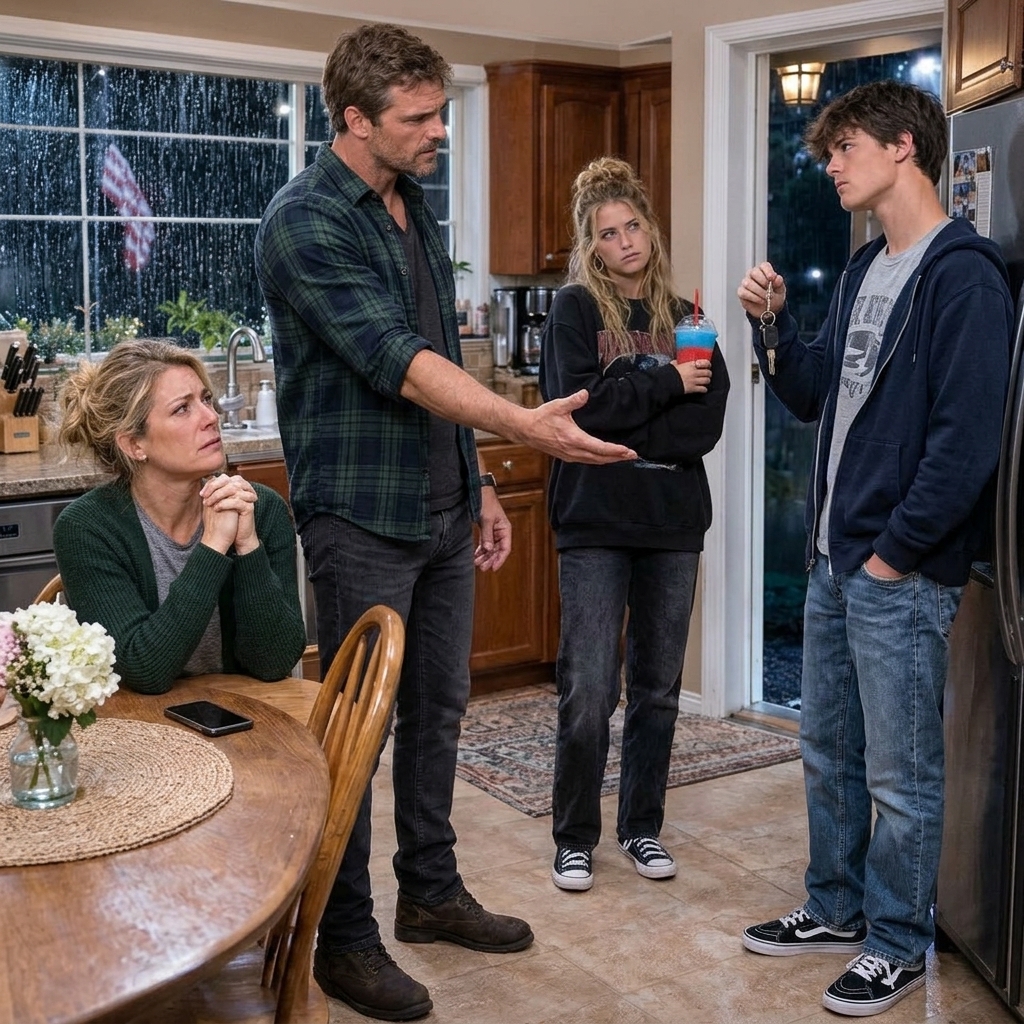
His father had worked several temporary maintenance assignments for the district during the previous school year.
“I was in the building more often than you realized.”
Thomas looked down at the memorandum.
“I saw how some of those older boys treated younger students.
I heard complaints from cafeteria workers.
I watched a freshman come out of the gym crying one afternoon.”
Eli felt his chest tighten.
“Daniel?”
Thomas nodded.
“I spoke to him.
Then I reported what I’d seen.”
“Why didn’t you tell me?”
“Because I didn’t want you to feel responsible for fixing something the adults were supposed to handle.”
Eli sat slowly.
Thomas continued.
“I thought the reports would lead to changes.
When nothing seemed to happen, I kept asking questions.”
Grace looked at him.
“I didn’t know you had submitted this many.”
“Neither did I,” Thomas admitted.
“Not until I saw the list.”
Eli examined the dates.
One report had been filed two days before the cafeteria confrontation.
It described ongoing concerns about intimidation near the radiator tables.
His father had reported the exact location.
The exact behavior.
And the possibility that a confrontation could occur if the behavior continued.
Eli felt a strange chill.
His father had warned the school about the very situation that eventually happened to him.
He looked up.
“You knew Marcus was bothering people at that table?”
“I knew there were complaints about it.”
“Why didn’t you tell me to stay away?”
Thomas’s face tightened.
“I should have told you about the concern.”
He paused.
“But I also believed the school was addressing it.”
Eli looked at the memorandum again.
Something else caught his attention.
The final report had a handwritten notation beside it.
Forwarded for administrative review.
Beneath that was another mark.
No further action recommended.
The initials belonged to a district administrator.
Not Marcus.
Not Coach Brennan.
Not even Principal Whitmore.
The report had been reviewed above the school level.
Eli felt the meaning settle over him.
The problem hadn’t been limited to one senior, one teacher, one coach, or one principal.
Warnings had traveled through the system, and the system had repeatedly allowed them to stop without meaningful action.
His father looked exhausted.
“I thought I was doing enough by reporting what I saw.”
Eli shook his head.
“You did more than most people.”
Thomas looked at him.
“Not enough to stop what happened.”
Eli considered that.
Then he reached across the table and took his father’s hand.
“No,” he said quietly.
“But you tried.”
They sat together as the evening light faded from the windows.
For the first time, Eli saw the larger shape of what had happened.
The cafeteria confrontation hadn’t appeared from nowhere.
It had grown out of hundreds of smaller moments.
A warning dismissed.
A complaint minimized.
A student encouraged to stay quiet.
A teacher afraid of causing trouble.
A coach more concerned about winning than intervention.
A parent who confused protecting his son’s future with protecting him from responsibility.
And a boy who had learned that being feared was the same as being respected.
No single recording could explain all of that.
But the blinking pen had helped prevent one crucial afternoon from being rewritten.
And once the truth of that afternoon emerged, people had finally begun examining everything that came before it.
By graduation, Marcus Bell was a different young man.
Not perfect.
Not completely free of anger.
But different in ways that mattered.
He completed his disciplinary requirements, continued counseling, and finished his classes.
He did not return to the football team that season.
Instead, he spent several afternoons each week helping maintain a community recreation center.
At first, he considered the work humiliating.
He had once been the most recognizable athlete in his school.
Now he was sweeping floors, arranging folding chairs, and helping younger children carry equipment.
But over time, the work began to change him.
Nobody at the center cared how much he could bench press.
Nobody asked about college scouts.
The children liked him because he helped them reach basketball hoops, listened when they argued, and remembered their names.
One afternoon, a little boy knocked over a stack of chairs.
The crash echoed across the gym.
Marcus turned sharply.
The child froze.
For one brief instant, Marcus felt the old anger rise.
Then he stopped.
He took a breath.
Walked over.
And helped the boy pick up the chairs.
“It’s okay,” Marcus said.
“Let’s do it together.”
The moment lasted less than a minute.
Nobody applauded.
Nobody recorded it.
But afterward, Marcus sat alone for several minutes, staring at his hands.
He realized something extraordinary.
For the first time in years, somebody had made a mistake in front of him, and he hadn’t needed to make that person afraid.
Popular Posts
→- 1
- 2
- 3
- 4




Recently Viewed
Stories you read recently will appear here.