When I told Natalie,
she became very serious.
“We need to establish”
“exactly what was signed.”
I nodded.
“And whether anything was altered”
“or later represented inaccurately.”
My hands trembled.
I felt sick.
The woman I’d welcomed
into my home
when she was pregnant
might have used
my trust in her
to obtain financial authority
I never intended to grant.
I looked at Thomas’s photograph.
Then whispered,
“What happened to our family?”
***
That was the question
I’d been asking myself
for six months.
How had we reached
a point where
my own home
felt unfamiliar?
Where my son
couldn’t look me in the eye?
Where his wife
spoke about my future
as though I weren’t present?
And where documents
were being prepared
in my name
without my understanding?
I spent many nights awake.
Sometimes,
I sat in Thomas’s restored study.
His old drafting lamp
cast a warm circle
across the desk.
I read his journals.
Looked at photographs.
And remembered
the life we’d built together.
Thomas wasn’t perfect.
Neither was I.
We argued about money.
Disagreed about parenting.
Made mistakes.
But one thing
had always remained clear.
The house was ours.
Our decisions were shared.
And neither of us
would have imagined
telling the other
they no longer belonged.
I missed him terribly.
Not just because
he would have defended me.
But because
I wanted someone
to sit beside me
and say,
“Eleanor, you’re not imagining this.”
Ruth said it often.
Natalie said it
through facts and documents.
But sometimes,
I still wanted
to hear Thomas’s voice.
***
The trust deed
was prepared for recording.
Natalie coordinated
the necessary filings.
She also began
a separate legal response
to the questionable authorization.
The goal was simple.
Establish my ownership.
Clarify that no unauthorized person
could act for me.
Preserve the disputed documents.
And prevent anyone
from relying on them
without proper verification.
Some matters required
formal notice.
Others required
court review.
I understood
that filing documents
didn’t automatically decide
every disputed issue.
But it created
an official record
that I was asserting
my rights.
And that mattered.
***
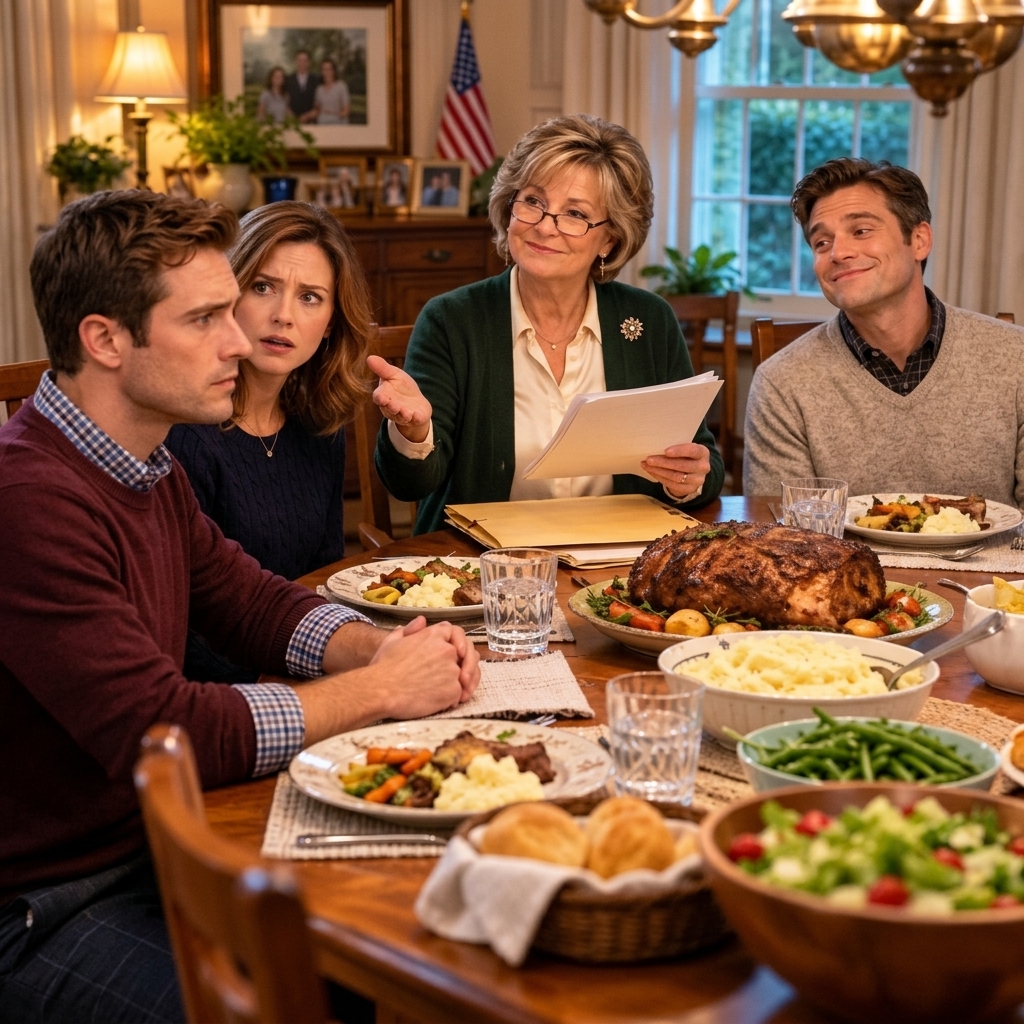
Then came the dinner.
The announcement
about Connor and Melinda’s new house.
The congratulations.
The children’s excitement.
And Melinda’s extraordinary suggestion
that I should start
figuring out how
to live alone.
When she said
they no longer needed me
living in my own house,
something finally became clear.
The valuation hadn’t been harmless.
The relocation note
hadn’t been a misunderstanding.
And the financial authorization
wasn’t the only concern.
Someone had been preparing
for a future
in which I was no longer
part of the decision-making process.
I opened the second folder.
And returned my attention
to the people
sitting around my dining table.
***
“Connor,” I said quietly.
He looked at me.
“Did you know”
“someone requested an appraisal”
“of this house?”
His face changed.
Melinda stiffened.
Ruth watched them carefully.
Connor swallowed.
“What appraisal?”
I placed the valuation
on the table.
“The one completed”
“six months ago.”
He stared at the document.
Melinda immediately spoke.
“That was just research.”
I looked at her.
“Research for what?”
She shrugged.
“We were exploring options.”
“Options involving my house?”
“Our family’s future.”
I held her gaze.
“Without discussing it with me?”
She sighed.
“Eleanor, you’re being unnecessarily suspicious.”
I turned toward Connor.
“Did you know about it?”
He hesitated.
“Melinda mentioned something.”
“What did she mention?”
“That the house had appreciated.”
I nodded.
“And?”
He looked toward his wife.
She shook her head slightly.
I noticed.
So did Ruth.
I leaned forward.
“Connor.”
He looked back at me.
“Please answer without asking”
“your wife for permission.”
His face reddened.
“Mom, that’s not fair.”
I took a breath.
“Neither is deciding”
“what happens to my property”
“without telling me.”
Jackson shifted uncomfortably.
I noticed immediately.
This wasn’t a conversation
the children should have
to sit through.
I turned toward Ruth.
“Would you take them”
“into the living room?”
Ruth nodded.
“Of course.”
Lily looked frightened.
“Grandma, are you okay?”
My heart tightened.
I smiled gently.
“I’m okay, sweetheart.”
“This is an adult conversation.”
“You haven’t done anything wrong.”
She hesitated.
Then followed Ruth.
Jackson lingered.
He looked at Connor.
Then at Melinda.
Finally,
he quietly left the room.
I waited
until their footsteps faded.
Then I turned back
to my son and daughter-in-law.
“Now.”
I folded my hands.
“Let’s tell the truth.”
***
Melinda laughed nervously.
“You’re turning nothing”
“into a family crisis.”
I looked at her.
“Then answer a simple question.”
She crossed her arms.
“Fine.”
“Why did you tell”
“the real estate agent”
“that I was relocating?”
Her expression changed.
“What?”
I pointed to the proposal.
“Owner relocation expected before closing.”
Melinda stared at the page.
Connor leaned forward.
“Before closing?”
He looked at his wife.
“Melinda, what is that?”
Popular Posts
→- 1
- 2
- 3
- 4




Recently Viewed
Stories you read recently will appear here.