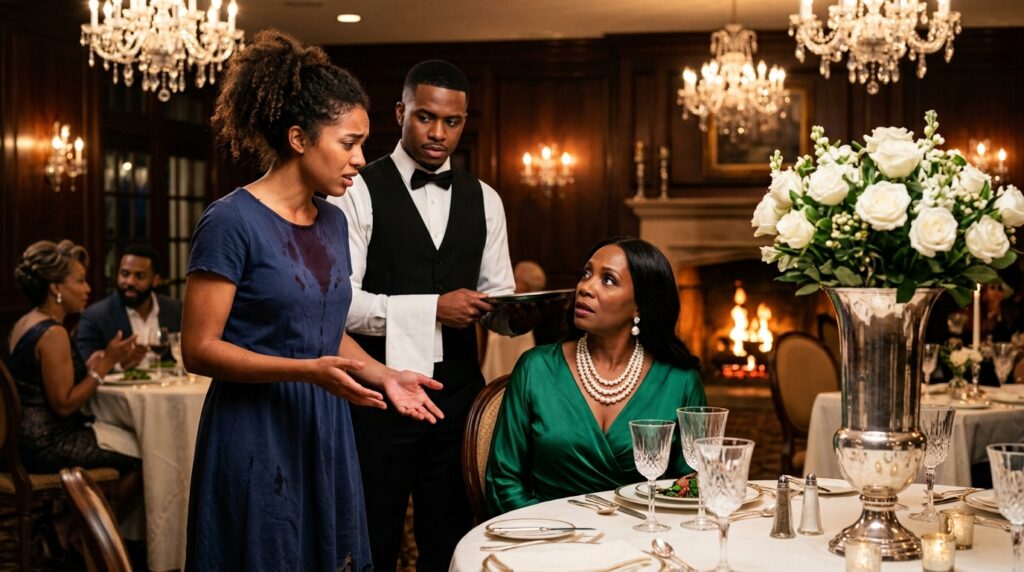
“Clean up that wine and get out, you pathetic orphan,” Diane Mercer whispered after her hand cracked across my face in front of thirty-seven dinner guests.
Then she shoved a leather bill folder against my chest.
“Since you’re so desperate to sit with real family,” she said, smiling through her champagne, “you can pay like one.”
The waiter stood beside me with a frozen expression, holding a receipt for $4,186.73.
Crystal chandeliers glittered above us.
White roses spilled from silver vases.
A string quartet played something soft near the fireplace, as if music could make cruelty look elegant.
My cheek burned.
My left hand trembled.
But I did not cry.
I had learned a long time ago that tears were expensive in Diane’s house.
Tears cost you dinner.
Tears cost you sleep.
Tears cost you the last clean towel.
So I stood there in my thrift-store navy dress, one heel sticky with spilled Cabernet, and stared at the bill my aunt expected me to pay with the emergency savings I had hidden for six years.

The Magnolia Room at the Harbor Club in Savannah was the kind of place people chose when they wanted everyone to know they had money.
Tall windows looked out over the river.
Men wore tailored jackets.
Women wore pearls they touched whenever they pretended to be shocked.
At the center table sat my grandmother, Eleanor Whitaker, wrapped in a silver shawl, celebrating her eightieth birthday beneath a banner that read:
FAMILY IS OUR LEGACY.
I almost laughed when I saw it.
Almost.
Because for twenty-four years, my family’s legacy had been a mattress in Diane’s basement, a secondhand school backpack, and my name spoken like an inconvenience.
My parents, James and Lucy Whitaker, died when I was six.
A rainy highway.
A jackknifed truck.
A phone call in the middle of the night.
After that, Diane and her husband, Richard, became my guardians.
That was the word the court used.
Guardians.
As if they had protected me.
As if they had raised me.
As if they had not moved me into the laundry room because their “real children” needed space for piano, lacrosse equipment, and a gaming console they barely used.
I grew up beneath humming pipes and the sour smell of detergent.
I studied nursing textbooks on a folding tray.
I learned to sleep through the dryer shaking the wall.
I learned that Diane’s kindness arrived only when people were watching.
Tonight, everyone was watching.
That was why she smiled.
Three minutes before she slapped me, Diane had stood at the head of the table with a champagne flute raised high.
She wore emerald silk, diamond earrings, and the satisfied expression of a woman who had practiced grief in the mirror.
“My poor sister Lucy,” she said, pressing a napkin to the corner of one dry eye. “She left this world with nothing. Nothing but her little girl.”
People sighed.
Someone touched their chest.
My cousin Madison tilted her head like she was watching a sad commercial.
Diane continued, voice shaking perfectly.
“Richard and I sacrificed everything to give Annabelle a home. We never complained. We never asked for help. We just opened our hearts.”
I looked down at my plate.
The scallops in front of me had gone cold.
Opened our hearts.
Opened our basement door at 6 a.m. and told me to shovel snow before school.
Opened my birthday cards before I got home.
Opened every envelope addressed to me until I turned eighteen.
Opened my mother’s jewelry box and said nothing inside belonged to me.
I said nothing.
I had come for Grandma Eleanor.
Only for her.
She had been distant most of my childhood because Diane controlled access like a prison guard. Calls were missed. Letters disappeared. Visits were “bad timing.”
But three months ago, Grandma had found me after I took a job at St. Catherine’s Hospital.
She came into the emergency department with a bruised wrist from a fall in her garden.
I recognized her before she recognized me.
She stared at my name badge.
Annabelle Whitaker, RN.
Then her eyes filled.
Not with pity.
With fury.
Since then, she had called every Sunday.
Short calls at first.
Then longer ones.
Then one afternoon she asked me a strange question.
“Annie, did Diane ever explain your parents’ trust?”
I had laughed because I thought she was joking.
Tonight, I understood she had not been joking at all.
Diane finished her speech by placing one manicured hand over her heart.
“Family means sacrifice,” she said.
Then she looked directly at me.
“Doesn’t it, Annabelle?”
I lifted my eyes.
Every face turned.
I should have smiled.
I should have nodded.
I should have played the quiet orphan like I always did.
Popular Posts
→- 1
- 2
- 3
- 4




Recently Viewed
Stories you read recently will appear here.