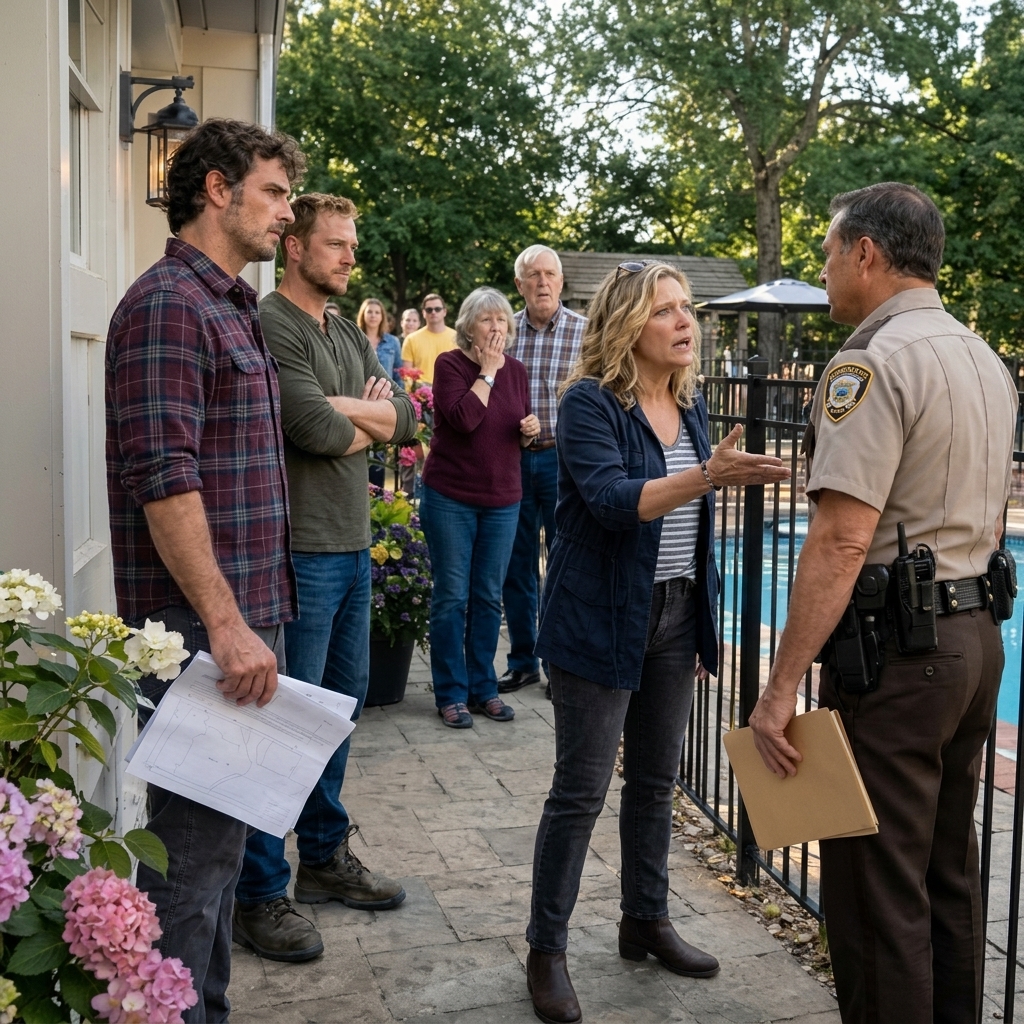
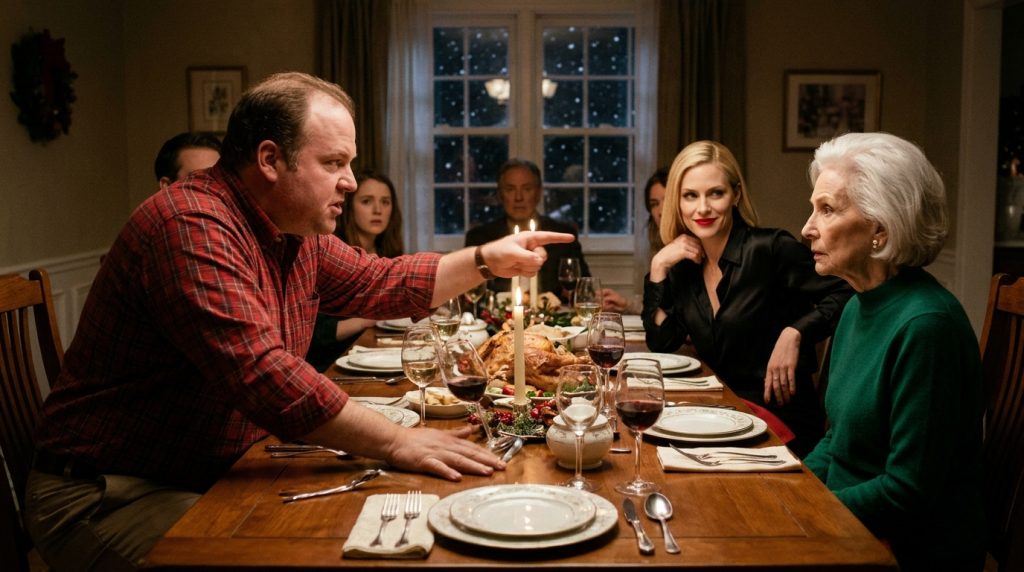
She stared back with a strange expression.
Not guilt.
Calculation.
Even now.
Even here.
Even with the room watching.
She was measuring exits.
Grandma lifted her chin.
“As of noon today, my estate has been amended,” she said. “Diane, Richard, Madison, and Kyle are removed from all inheritance, trusts, family business benefits, and property transfers.”
Diane’s face twisted.
“You can’t do that.”
“I did,” Grandma said.
Thomas added, “The revised estate leaves controlling interest of Whitaker Holdings, the River House property, and all liquid assets to Annabelle Whitaker.”
The room exploded.
Not loudly at first.
Whispers.
Gasps.
A chair scraping.
Then Diane screamed.
A raw, animal sound.
“You dirty little thief!”
She came for me.
Security caught her before she reached the table, but her fingers clawed the air inches from my face.
“You think that makes you family?” she shrieked. “You think money washes basement stink off you?”
I looked at her hands.
The same hands that had slapped me.
The same hands that had signed checks from my trust.
The same hands that had packed away my mother’s jewelry and my father’s letters.
For the first time in my life, Diane Mercer looked small.
Not poor.
Not ruined.
Small.
I picked up the bill folder and placed it in front of her.
“Clean up your own wine,” I said.
Then I walked out of the Magnolia Room with my grandmother’s arm linked through mine and my parents’ unopened letter pressed against my heart.
Outside, Savannah smelled like rain and river mud.
The valet stared at me but said nothing.
Grandma’s driver pulled the black town car to the curb.
Thomas followed us, phone already at his ear, speaking in low legal phrases that sounded like doors locking.
Temporary injunction.
Asset freeze.
Emergency petition.
Criminal referral.
I should have felt victorious.
Instead, I felt hollow.
Like someone had opened a wall in my chest and found a room I never knew existed.
In the car, Grandma sat beside me and held my hand.
“I am so sorry,” she whispered.
I looked at her.
Her lipstick was slightly smudged.
Her silver hair had loosened from its pins.
For the first time, she looked not like Eleanor Whitaker, matriarch of a wealthy old family, but like an eighty-year-old woman who had lost her son twice.
Once to death.
Once to deception.
“You didn’t know,” I said.
“I should have.”
I shook my head.
“Diane built a whole life out of making people doubt what they saw.”
Grandma squeezed my hand.
“That ends now.”
I believed her.
That was my mistake.
The next morning, my apartment was too quiet.
I lived on the second floor of a brick building behind St. Catherine’s, in a one-bedroom place with thin walls and a refrigerator that clicked all night.
The sun came through cheap blinds in narrow stripes.
I sat cross-legged on the floor with coffee going cold beside me and my parents’ letter in my lap.
I had not slept.
I had watched dawn turn the ceiling gray.
Finally, I opened it.
The envelope tore unevenly because my hands would not behave.
Inside were three pages.
My father’s handwriting began strong and square.
My mother’s appeared in the margins, softer, looping through his sentences like she could not resist adding love.
My sweet Annie,
If you are reading this, then the worst thing has happened and we are not there to say this ourselves.
I stopped there.
Pressed the paper to my mouth.
Breathed.
Then kept reading.
They wrote about my laugh.
My obsession with ladybugs.
The way I insisted pancakes tasted better when cut into stars.
They wrote about money, yes, but not like rich people do.
Not as power.
As protection.
Your trust is not a prize, sweetheart. It is a fence around your future. It is there so no one can make you feel grateful for crumbs.
My mother had underlined that sentence.
No one can make you feel grateful for crumbs.
I read it five times.
Near the end, my father wrote something strange.
There are documents in the blue fireproof box that explain everything. If anything about our deaths feels wrong to you, give the box to Thomas Garrett or your grandmother. Trust no one else with it. Not even family.
The blue fireproof box.
I stared at the words until they blurred.
I had never seen a blue fireproof box.
I had never heard of it.
Diane had.
I knew it instantly.
Not because I remembered the box.
Because I remembered the night.
I was seven.
Maybe eight.
I had woken up in the basement to voices above me.
Diane and Richard fighting in the kitchen.
Richard had said, “We should have burned the whole thing.”
Diane had answered, “Not until I know what James kept.”
Popular Posts
→- 1
- 2
- 3
- 4




Recently Viewed
Stories you read recently will appear here.